
Key Collection Process for New Property in Dubai: The 2026 Homeowner's Guide
- Sohrab Virani
- Mar 14
- 14 min read
Imagine standing at the gates of your new villa in Tilal Al Ghaf, only to have your entry blocked by a missing AED 2,500 administrative clearance you didn't know existed. For many investors, the key collection process new property dubai developers facilitate feels like a complex maze of conflicting instructions between the Dubai Land Department and various utility providers. You've invested significant capital into your future, and the final step of your journey should feel like a hard-earned celebration, not a bureaucratic struggle.
It's natural to feel anxious about hidden handover fees or the risk of accepting a property with structural defects. You deserve a transition that's both transparent and professionally managed. This guide provides a definitive roadmap to securing your home with total confidence and full regulatory compliance. We'll walk you through the essential stages of the handover, providing the oversight you need to settle your final accounts, conduct a professional snagging inspection, and ensure your DEWA activation is seamless so you can step into a perfect home on day one.
Key Takeaways
Navigate the financial clearance phase with confidence by understanding final payment obligations and the mandatory 4% DLD registration fee.
Streamline your transition using the key collection process new property dubai roadmap, leveraging digital portals and the Dubai REST app for a stress-free handover.
Protect your investment by identifying why professional snagging is a non-negotiable step to avoid the risks of "deemed acceptance" and property defects.
Secure your peace of mind post-handover by mastering the 12-month Defects Liability Period and the role of expert community management in preserving your asset.
Table of Contents What is the Key Collection Process in Dubai? Financial and Document Clearance: The Pre-Handover Phase Snagging and Inspection: Ensuring Quality Before Keys The Handover Appointment: Step-by-Step Key Collection Post-Handover: Transitioning to Community Living
What is the Key Collection Process in Dubai?
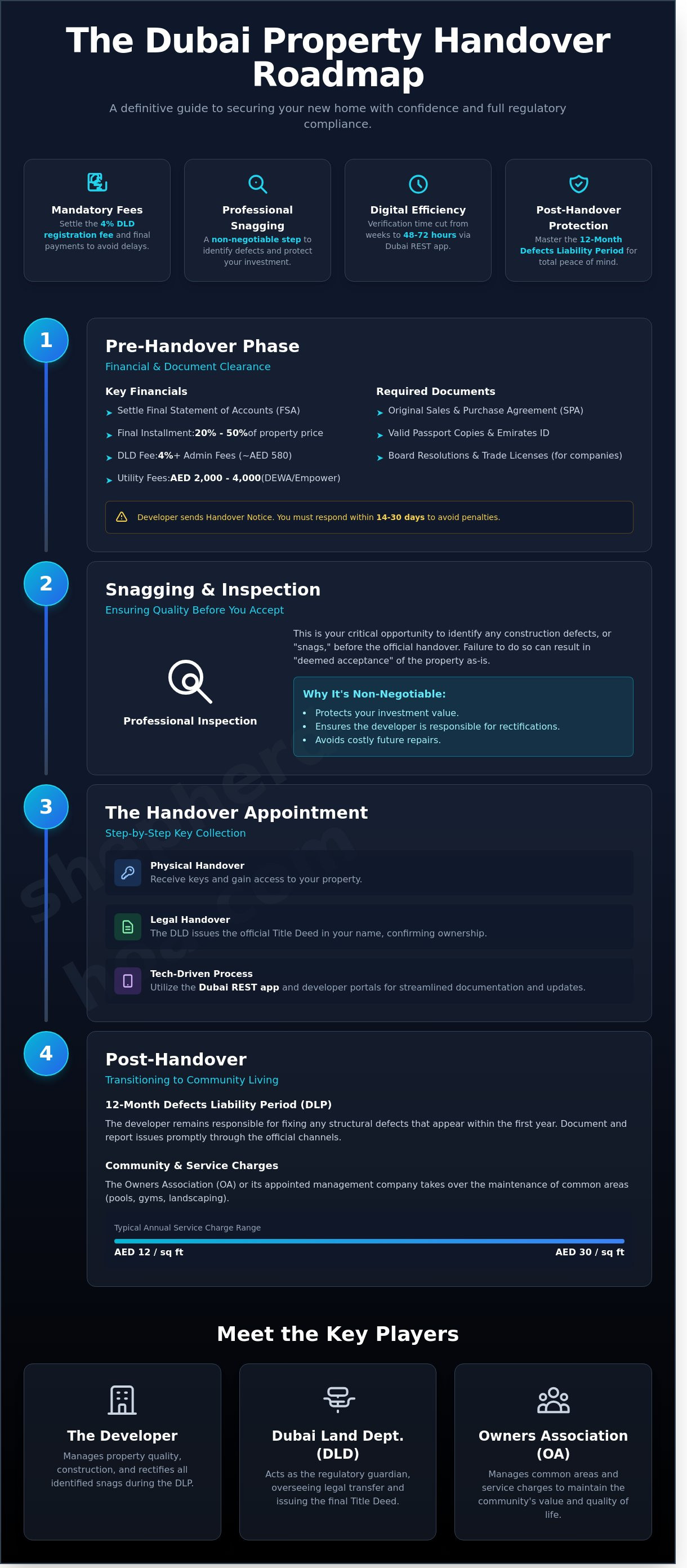
The key collection process new property dubai marks the formal transition from a construction project to a liveable asset. This procedure officially begins once the developer secures the Building Completion Certificate (BCC) from the relevant authorities, such as Dubai Municipality or Trakhees. It signifies that the structure is safe, compliant with safety codes, and ready for occupancy. For investors and homeowners, this is the moment where the abstract promise of a floor plan becomes a physical reality. The real estate market in Dubai has evolved to make this transition as efficient as possible, moving away from paper-heavy traditional methods toward a tech-driven approach.
In the 2026 real estate environment, digital transformation defines every interaction. The Dubai Land Department (DLD) now utilizes the Dubai REST app to synchronize developer data with owner records in real-time. This integration has cut the administrative wait time for document verification from several weeks to just 48 to 72 hours. You'll find that most reputable developers now use dedicated portals to manage your payments, document uploads, and snagging reports. This streamlined approach protects your investment by ensuring every step is recorded transparently on the blockchain.
You must distinguish between the physical handover and the legal handover. The physical handover occurs when you receive the keys and gain access to the unit. The legal handover is the point where the DLD issues the Title Deed in your name. While these often happen close together, the legal transfer requires that all registration fees, typically 4% of the property value plus administrative fees of approximately AED 580, are settled in full. Shepherd HomeOwners' Association views this phase as the foundation of your long-term property value, as it sets the stage for how the community is managed and maintained.
The Handover Notice: Your First Step
Your administrative journey starts when the developer sends the official Handover Notice. This document includes the Final Statement of Accounts (FSA), which details any remaining installments, service charge prepayments, and utility connection fees. Most developers require a response within 14 to 30 days. Ignoring this notice can trigger delayed payment penalties or storage fees for your keys. Even if you don't plan to move in immediately, you must complete this step to avoid financial friction and ensure your home insurance remains valid.
Key Stakeholders in the Process
Three primary entities guide you through this transition. The Developer manages the unit's quality and ensures all construction milestones are met before inviting you for an inspection. They're responsible for rectifying any "snags" or defects found during the initial walk-through. The Dubai Land Department (DLD) acts as the regulatory guardian, overseeing the legal transfer and issuing the Title Deed to prove your ownership. Finally, the Owners Association (OA) or their appointed management firm enters the picture to oversee common areas. They manage the service charges, which typically range from AED 12 to AED 30 per square foot, ensuring the pool, gym, and elevators remain in peak condition. This collaborative ecosystem ensures your new community remains a stable, high-value environment for years to come.
Financial and Document Clearance: The Pre-Handover Phase
The financial clearance phase is where your investment transitions into a tangible asset. Before the developer invites you to the site for an inspection, your financial ledger must be perfectly balanced. This stage of the key collection process new property dubai requires meticulous attention to detail to avoid administrative delays. Developers in the UAE enforce a strict zero balance policy. You'll need to settle the final installment of your payment plan, which often accounts for 20% to 50% of the total purchase price depending on your specific agreement. Keys aren't released until the developer's finance department confirms the funds have cleared in their escrow account.
Beyond the property price, you're responsible for the Dubai Land Department (DLD) registration fee. This is calculated at 4% of the property value, plus a standard administrative fee that usually totals around AED 580 for apartments or AED 430 for land. If you didn't pay this during the off-plan stage, it's due now. You'll also need to prepare your Handover Pack. This collection includes your original Sales and Purchase Agreement (SPA), valid passport copies, and your Emirates ID. For corporate buyers, Board Resolutions and Trade Licenses are mandatory. Ensuring these documents are ready prevents bottlenecks that could stall your move-in date by several weeks.
Navigating the Final Statement of Accounts
The Final Statement of Accounts (SOA) often contains costs that catch new owners off guard. You'll likely see charges for DEWA and Empower connection fees, which can range from AED 2,000 to AED 4,000. Another critical factor is the final area measurement. If the completed unit is larger than the size stated in your SPA, developers may charge for the extra square footage. Conversely, if the unit is smaller by more than 5%, you're entitled to a credit or refund under DLD regulations. Always verify these figures against a 15-point handover checklist to ensure every dirham is accounted for. Once the balance is cleared, the developer issues a No Objection Certificate (NOC), signaling that you've fulfilled your contractual duties.
Service Charges and the Mollak System
In Dubai, it's standard practice for developers to collect the first year of service charges in advance. These funds cover the maintenance of common areas, security, and landscaping. By 2026, the Mollak system will strictly regulate these payments to ensure 100% transparency for all homeowners. This system, managed by RERA, prevents developers from overcharging and ensures your money goes directly into a regulated account. You should always confirm your community is registered in Mollak before transferring funds. For a deeper dive into these costs, read our guide on understanding your service charge invoice in Dubai. This financial clarity is the backbone of community harmony and helps protect your long-term property value.
Completing this financial hurdle is the final step before the physical inspection. It's a complex part of the key collection process new property dubai, but staying organized ensures a smooth transition. If you find the administrative burden of managing community documents or financial oversight overwhelming, Shepherd HOA provides the tools to simplify these responsibilities for board members and owners alike. Our platform acts as a steady guide through the complexities of property management, ensuring your community remains a well-guarded asset.
Snagging and Inspection: Ensuring Quality Before Keys
The final stage of the key collection process new property dubai begins with a rigorous inspection, not just a signature. You shouldn't collect keys before a professional snagging inspection is complete. This step is your primary defense against inheriting a property with hidden defects. Once you accept the keys and sign the handover documents, your leverage over the developer decreases significantly. You're effectively signaling that the unit meets your expectations, which shifts the burden of proof for any future repairs onto your shoulders.
Many buyers fall into the "Deemed Acceptance" trap. Most Sales and Purchase Agreements (SPAs) in Dubai include a clause stating that if you don't provide a formal list of defects within a specific timeframe, usually 5 to 10 days after the handover notice, you've legally accepted the property in its current condition. This means you lose the right to demand repairs for cosmetic or minor functional issues. You're left to cover the costs of fixing paint chips, misaligned cabinetry, or scratched glass out of your own pocket. These small costs quickly add up to thousands of AED.
Common defects in new Dubai builds often go beyond surface level aesthetics. While uneven flooring and poor paint finishes are frequent, MEP (Mechanical, Electrical, and Plumbing) issues pose the greatest risk. Statistics from regional building consultants indicate that 15% of new units experience AC drainage leaks or ducting issues within the first 12 months. Faulty wiring or improperly sealed wet areas in bathrooms can lead to mold growth and water damage that compromises the building's integrity. A comprehensive snagging report identifies these systemic failures while the developer is still contractually obligated to fix them.
The Professional Snagging Process
You might consider doing the inspection yourself to save money, but this is often a false economy. Professional snaggers use specialized equipment like thermal imaging cameras to find moisture behind walls and AC leaks that aren't visible to the eye. By 2026, digital logs and real-time reporting will be the mandatory industry standard for snagging in the UAE. Professionals provide a structured report with GPS-stamped photos that developers can't easily dispute. A typical professional inspection for a two-bedroom apartment costs between AED 1,800 and AED 3,500. It's a small investment to protect an asset worth millions. You can prepare by reviewing Your Dubai Property Snagging & Inspection Checklist to understand the level of detail required for a successful claim.
Rectification and Re-inspection
After you submit the snagging report, the developer enters the rectification phase. This period typically lasts between 14 and 30 days. You should never sign the Handover Certificate (HOC) until you've conducted a follow-up inspection to verify that every item on your list has been addressed. Developers often rush these fixes, sometimes painting over cracks rather than repairing the underlying cause. If a developer refuses to fix major structural snags or critical MEP failures, don't feel pressured to move forward. You have the right to escalate the matter to the Dubai Land Department (DLD). Their Technical Department acts as a mediator to ensure developers adhere to the building standards promised in your contract. Protecting your investment now ensures community harmony and preserves property values for years to come.
The Handover Appointment: Step-by-Step Key Collection
The key collection process new property dubai officially begins with a formal appointment, marking the transition from a construction project to your personal residence. You'll typically schedule this session through the developer’s dedicated portal or the Dubai REST app, which serves as the official digital hub for the Real Estate Regulatory Agency (RERA). This meeting isn't just a formality; it's the moment the risk and responsibility for the asset shift to you. Developers usually provide a specific 30 to 60 minute window for this process, so arriving prepared with your original Emirates ID and the final payment receipt is essential for a smooth experience.
During the appointment, you'll receive the comprehensive handover kit. This package is the physical manifestation of your investment. It includes:
Main Entry Keys: At least three sets of keys for the primary entrance and any secondary access points.
Access Cards: RFID cards or fobs required for the building lobby, gym, swimming pool, and basement parking.
Appliance Manuals: Documentation and warranty cards for any developer-installed items like ovens, dishwashers, or water heaters.
Property Documents: A copy of the approved floor plan and the snagging report summary.
The session concludes with the signing of the Handover Certificate. By signing this document, you're confirming that the property is in an acceptable state and that you've received all necessary access tools. It's a significant legal step that terminates the developer's liability for minor cosmetic issues not recorded during the final walkthrough. Take your time to ensure every key turns smoothly and every access card grants entry before you put pen to paper.
Setting Up Your DEWA and Utilities
The 2026 digital integration initiative has streamlined utility activation into a near-instant process. Once the Dubai Land Department issues your Title Deed, a digital link automatically triggers the creation of your DEWA account. You'll receive an SMS to pay the security deposit, which is currently AED 2,130 for apartments and AED 4,130 for villas, including connection fees. If your community uses district cooling, you'll need to finalize a separate agreement with providers like Empower or Emicool to ensure your air conditioning is functional before you move. For a detailed walkthrough on these requirements, see our guide on how to set up your DEWA account in Dubai.
Logistics of the Move-In
Securing your keys doesn't mean you can immediately bring in the moving trucks. Most Dubai communities require a 'Move-In Permit' (MIP) issued by the community management office. You must apply for this at least 48 hours in advance through the community's online portal. Booking the service elevator is a critical step, especially in high-rise towers where demand is high during handover month. Most buildings restrict heavy moving to specific windows, typically 9:00 AM to 6:00 PM, Monday through Saturday. You'll also need to register your household staff and vehicle license plates with the security team to ensure the key collection process new property dubai results in a stress-free transition into your new home.
Ensuring your community runs smoothly after handover requires expert oversight. Partner with Shepherd HOA to bring professional management and peace of mind to your new neighborhood.
Post-Handover: Transitioning to Community Living
Completing the key collection process new property dubai marks your official transformation from a prospective buyer into a vested member of a residential community. This shift involves moving beyond the individual four walls of your apartment or villa to understand your role within the larger ecosystem of the development. Your property value doesn't exist in a vacuum; it's directly tied to the collective maintenance of common areas and the efficiency of the homeowners association. Shepherd HOA acts as the guardian of this value, ensuring that the transition remains organized and your investment stays protected through rigorous administrative oversight.
Dubai Law No. 6 of 2019 regulates the ownership of jointly owned properties, establishing a framework where owners have a say in their community's future. You're now part of a collective that funds the upkeep of shared infrastructure through service charges. These fees, often ranging from AED 12 to AED 30 per square foot depending on the area and luxury level, pay for the security, cleaning, and landscaping that keep the neighborhood desirable. Active participation in this phase ensures that your voice helps shape the community standards for years to come.
The 1-Year Defects Liability Period (DLP)
Your property comes with a dual layer of protection mandated by UAE law. The developer provides a 10 year structural warranty and a 1 year non structural warranty, commonly known as the DLP. This 365 day window is critical for identifying "snags" that weren't visible during the initial key collection process new property dubai. You should report issues like AC malfunctions, plumbing leaks, or electrical faults immediately. Keep a precise digital log of every ticket raised through the developer’s portal, including dates and photos, to ensure a paper trail exists if repairs aren't completed by the end of the first year.
Why Professional Community Management Matters
Shepherd HOA ensures that every dirham of your service charge is spent ethically and transparently. We manage the delicate balance of maintaining 2026 standards for high traffic areas like temperature controlled pools and state of the art gyms while keeping costs optimized. By providing clear financial reporting and strictly vetting service providers, we remove the friction from community governance. Our role is to act as the invisible backbone of your neighborhood, allowing you to enjoy your home while we handle the complexities of compliance and vendor management. Discover how Shepherd HOA enhances your community living experience.
Joining the Owners' Committee is the most effective way to influence community decisions. While the committee doesn't manage the property directly, it acts as an advisory body to the management company and a liaison to the Dubai Land Department. Members review annual budgets and provide feedback on community rules. This involvement prevents the common "buyer's fatigue" that sets in after handover. Instead of feeling like a passive observer, you become an active stakeholder. To stay organized during this transition, consider these steps:
Register on the Mollak System: Ensure your title deed is linked to the Dubai Land Department's online portal for transparent service charge billing.
Review the Building Management Statement (BMS): Understand the specific rules regarding move-in hours, renovations, and pet policies.
Attend the First General Assembly: This meeting usually occurs within the first few months of handover to elect the committee.
Verify Utility Transfers: Double check that DEWA and Chiller accounts are fully moved into your name to avoid service interruptions.
The first 12 months in a new Dubai property are the most telling. By staying diligent with the DLP and supporting professional management, you ensure your home remains a sanctuary rather than a source of administrative stress. Shepherd HOA remains committed to providing the organized control you need to settle into your new life with total peace of mind.
Secure Your Investment and Begin Your Life in Dubai
Completing the key collection process new property dubai marks your official transition from buyer to homeowner. You've verified that your unit meets 100% of the agreed quality standards during snagging and finalized all financial obligations through the Mollak system. Now, the focus shifts to protecting your asset's long-term value. A well-managed community is the backbone of your investment, requiring strict adherence to RERA regulations and transparent financial oversight.
Shepherd HOA acts as your steady guide during this critical phase. We provide RERA approved community management and expert Mollak financial reporting to ensure your neighborhood's accounts remain compliant and clear. Our team offers dedicated property handover support to handle the administrative complexities that often overwhelm new boards. We replace the stress of community governance with organized control and professional reliability.
Ensure a seamless transition to your new community with Shepherd HOA. Your journey as a Dubai property owner is just beginning, and we're here to help your community thrive from day one.
Frequently Asked Questions
How long does the key collection process take in Dubai?
The key collection process for a new property in Dubai typically takes between 14 and 30 days once the developer issues the formal handover notice. This timeline accounts for final payment clearances, document verification, and mandatory utility registrations. You can ensure a faster turnaround by having your 100% payment receipt and valid identification ready for the developer's handover department. Being prepared helps you avoid common administrative delays during this final transition.
Can I collect my keys if I am outside the UAE?
You can collect your keys from abroad by appointing a legal representative through a Dubai-notarized Power of Attorney. This representative handles the physical inspection and document signing on your behalf to maintain the momentum of your investment. Since 2020, the Dubai Courts have offered digital POA services; this allows you to authorize a trusted agent or professional property manager without the need to fly into the country.
What documents are required for property handover in Dubai?
You must provide your original passport, a copy of your Emirates ID or residency visa, and the fully signed Sales and Purchase Agreement. Developers also require a final settlement certificate showing a zero balance on the total property price. Most handovers in 2024 also require proof of DEWA registration and a copy of your Oqood or Title Deed to finalize the transfer of ownership into your name.
What happens if I find defects after I have collected the keys?
You have a 12-month defect liability period starting from the handover date to report any non-structural issues to the developer for repair. For structural defects, Dubai law provides a 10-year warranty under Article 26 of the Executive Council Resolution No. 6 of 2010. You should submit a formal snagging report through the developer’s portal to ensure all repairs are tracked and resolved within 14 business days to protect your asset.
Do I have to pay service charges before I get my keys?
Developers require you to pay the first installment of service charges, often covering 3 to 12 months in advance, before they release the keys. These fees are calculated based on the square footage of your unit and are vetted by the Real Estate Regulatory Agency (RERA). Clearing these dues ensures the homeowners association can maintain common areas and security from the moment you move in; this provides immediate peace of mind.
Is snagging mandatory for new properties in Dubai?
While snagging isn't a legal requirement under Dubai Land Department rules, it's a critical step in the key collection process for a new property in Dubai to protect your investment. Professional inspectors identify an average of 50 to 100 minor defects in new builds that the untrained eye might miss. Completing this before signing the handover form ensures the developer remains responsible for repairs rather than the cost falling on your shoulders.
What is the difference between a Title Deed and an Oqood?
An Oqood is a certificate for off-plan properties that registers the initial sale in the Dubai Land Department’s system during the construction phase. Once the building is 100% complete and handed over, this is converted into a permanent Title Deed. The Title Deed is the final proof of ownership, whereas the Oqood acts as a temporary registration that protects your rights before the project reaches completion.
How do I activate my DEWA account for a new property?
You activate your DEWA account by applying online through the official portal using your Ejari or Title Deed details. You'll need to pay a security deposit of AED 2,000 for apartments or AED 4,000 for villas to initiate the service. Most accounts are activated within 15 hours of payment; this ensures your water and electricity are running before you step through the front door for the first time.