
Mastering the Developer to Owner Handover Process in Dubai: A 2026 Guide

The moment you receive your keys isn't the end of your property journey; it's the most critical point of vulnerability for your investment. While it feels like a celebration, the developer to owner handover process dubai is actually a complex transition that demands your full attention to detail. You've likely felt the stress of managing administrative paperwork or the nagging fear that a hidden defect might cost you thousands later. We understand that the shift from an off-plan contract to a tangible asset can feel overwhelming, especially with evolving regulations like the 2025 Central Bank rule requiring all transaction fees to be paid upfront.
You deserve a transition defined by organized control rather than operational chaos. This expert guide provides a clear roadmap to managing legal compliance, professional snagging, and community management. We'll walk you through the essential steps to secure a defect-free property, manage your Mollak requirements, and establish a seamless governance structure that protects your asset's long-term value.
Table of Contents
Understanding the Developer to Owner Handover Process in Dubai
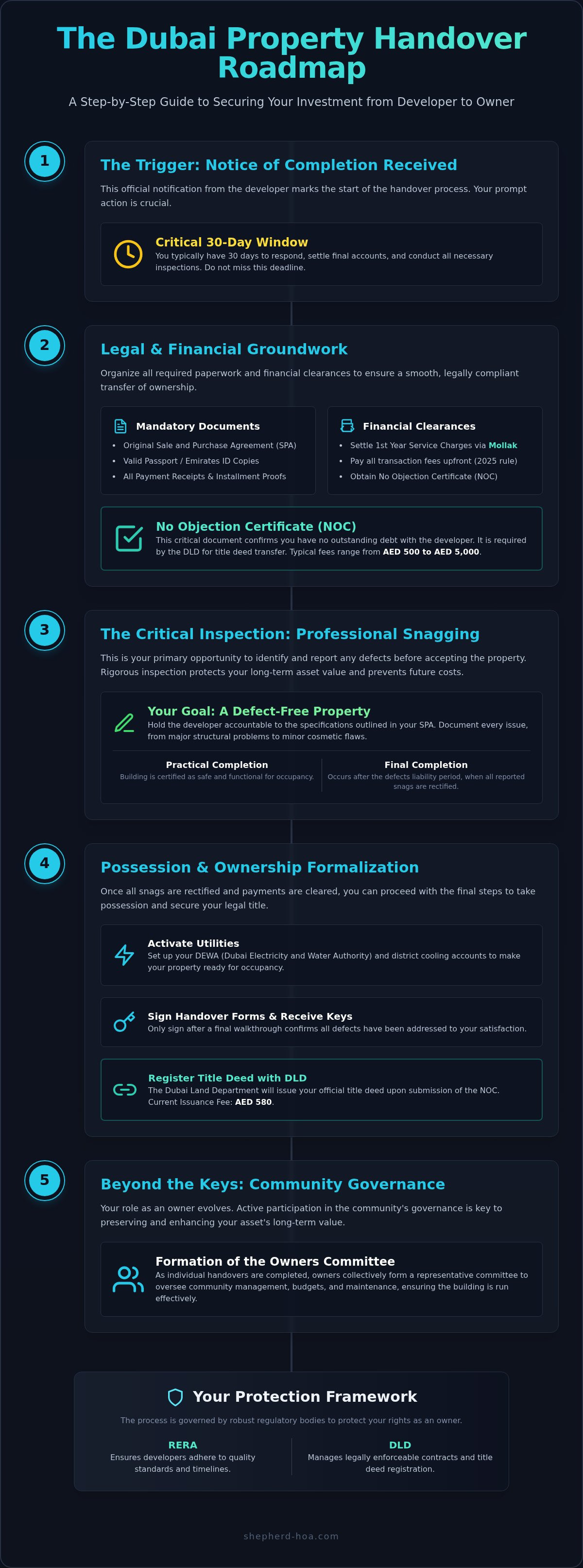
The developer to owner handover process dubai represents more than just a logistical milestone; it's the formal boundary between a construction project and a private asset. During this phase, the developer transfers physical possession and legal responsibility of the unit to you. This transition officially begins when you receive a "Notice of Completion." You typically have a 30-day window to respond, settle final accounts, and conduct your inspections. Navigating the developer to owner handover process dubai with precision ensures you aren't rushed into accepting a sub-par property or assuming liability for unfinished work.
It's vital to distinguish between two key documents during this period. A Practical Completion certificate indicates the building is safe and functional for occupancy. However, Final Completion usually occurs after the defects liability period, once all minor snags are rectified. Your Sales and Purchase Agreement (SPA) serves as the ultimate benchmark. It binds the developer to provide a unit that matches the promised specifications, free of structural or cosmetic defects. Your role is to hold the developer to these standards before the keys change hands.
Why the Handover Phase is Critical for Asset Value
Your vigilance during these few weeks dictates your financial burden for years to come. Rigorous oversight prevents long-term maintenance costs from falling on your shoulders prematurely. Once you sign the handover forms, the liability for service charges and utility bills shifts directly to you. In Dubai's real estate market, a property with a documented history of professional handover and rectified snags commands higher resale prices and better rental yields. It signals to future tenants or buyers that the asset has been protected from day one. Proper guardianship at this stage preserves the integrity of your investment.
The Role of RERA and the Dubai Land Department (DLD)
These regulatory bodies act as the framework for your protection. RERA ensures that developers adhere to strict timelines and quality standards, while the DLD manages the registration of your title deed. All contracts in the handover sequence must be DLD-registered to be legally enforceable. For a deeper look at your rights and the legal landscape, consult our RERA Dubai: The Complete 2026 Guide to Real Estate Regulation. This regulatory oversight ensures that your investment remains secure within a transparent, world-class system. By following these established protocols, you move from being a purchaser to a protected owner with full legal standing and peace of mind.
The Statutory Framework: Legal Requirements and Documentation
Success in the developer to owner handover process dubai depends on your attention to the legal and financial paperwork that anchors your ownership. You'll need a core set of documents to proceed, including your original Sale and Purchase Agreement (SPA), valid passport or Emirates ID copies, and all receipts for installments paid during construction. These documents aren't just administrative formalities; they're the evidence of your compliance with the contractual obligations that lead to the issuance of your title deed. For a smooth transition, ensure every payment record matches the developer's ledger before you attend the physical inspection.
The No Objection Certificate (NOC) from the developer is perhaps the most critical document in this phase. It confirms that you have no outstanding debts related to the property purchase. Depending on the project, NOC fees typically range from AED 500 to AED 5,000. Without this certificate, the Dubai Land Department cannot finalize the transfer of the title deed, which currently carries an issuance fee of AED 580. Obtaining this clearance is your signal that the developer acknowledges your full fulfillment of the purchase terms, allowing you to move forward with confidence.
Financial Clearances and Service Charges
Modern transparency in Dubai requires all service charge invoices to be registered through the Mollak system. You must settle the first year's service charges before the handover is finalized. It's a common area of confusion, but the Mollak system ensures your funds are handled ethically and used specifically for community maintenance. Under the 2025 UAE Central Bank regulations, remember that all transaction fees must be paid upfront and cannot be financed through your mortgage. For a deeper breakdown of how these costs are calculated and managed, read our guide on Understanding Mollak Dubai: The Complete 2026 Guide to Service Charges and Compliance. If you're feeling overwhelmed by these financial prerequisites, partnering with professional community management experts can provide the organized control you need.
The Importance of the Completion Certificate
Never accept the keys to a property until the developer provides the Building Completion Certificate (BCC) issued by the relevant municipality. The BCC is the official confirmation that the building is safe, habitable, and compliant with all approved engineering plans. This document triggers the official timeline for the developer to owner handover process dubai for every unit in the tower or villa cluster. Accepting a unit without a BCC puts your legal standing at risk and may complicate your insurance coverage or utility setups. It's your right as an owner to verify this certificate's existence before signing any final acceptance forms, ensuring your new home meets every statutory safety standard.
Navigating Key Milestones: Snagging and Inspections
The physical inspection is the most vital milestone in the developer to owner handover process dubai. It's the point where your contractual rights meet the reality of the construction. You shouldn't rely on a casual walk-through or your own untrained eye. Instead, follow a methodical five-step approach to protect your interests. First, appoint a professional third-party snagging company for a technical audit. Owners often lack the specialized tools to find sub-surface issues. Second, conduct the joint inspection with the developer’s representative. Third, document all defects in a formal report with clear photographic evidence. Fourth, agree on a specific timeline for the developer to rectify these issues. Finally, perform a de-snagging inspection to verify all repairs meet professional standards before you sign the final acceptance.
What to Look for During Professional Snagging
A surface-level check of taps and lights is insufficient. Professional auditors look deeper into the Mechanical, Electrical, and Plumbing (MEP) systems. They test AC performance under load and check for proper drainage in wet areas to prevent future mold or water damage. Architectural finishes like tiling, paintwork, and joinery are assessed for precision and durability. Modern inspections also use thermal imaging to detect hidden leaks behind walls or gaps in insulation that cause high cooling bills. This level of technical detail ensures no hidden costs surprise you after move-in, providing a sense of organized control over your new home.
The Snagging Report as a Legal Safeguard
Your signed snagging report is more than a punch list; it's a legal shield. Under UAE law, developers are bound by a one-year defect liability period for all fixtures and a ten-year structural warranty. If a defect is documented during the developer to owner handover process dubai, the developer is legally obligated to fix it. This report serves as vital evidence should any disputes arise later. For a comprehensive list of what to inspect, refer to our Mastering Property Handover in Dubai: The Complete 2026 Homeowner’s Guide. Having this documentation in place ensures social harmony and preserves your asset’s value from the very first day. It provides the steady guidance needed to transition from a buyer to a confident, protected owner.
Post-Handover Logistics: Utilities and Title Deeds
Once you've successfully completed the technical inspections and accepted the keys, the developer to owner handover process dubai shifts toward administrative functionality. You can't occupy or lease a property without active utility connections. This stage requires coordinating with several government and private entities to ensure your home is fully operational. It's best to initiate these applications immediately after signing the final handover forms to avoid any delays in moving in. We recommend starting with your electricity and water connections, as these are the foundation for all other services.
Beyond basic utilities, you'll need to finalize your telecommunications setup with providers like Etisalat or Du. If your building uses a central gas system, you'll also need to register with the specific gas provider for your community. Managing these moving parts requires a methodical approach to ensure nothing is missed. If the administrative burden of these setups feels overwhelming, our team provides comprehensive utility account setup and property handover services to handle the paperwork for you.
Setting Up Your DEWA and District Cooling
Activating your Dubai Electricity and Water Authority (DEWA) account is a priority. You'll need your Title Deed or the Sale and Purchase Agreement (SPA) along with your Oqood certificate. For apartments, the refundable security deposit is AED 2,000, while villas require AED 4,000. If your property is in a district cooling zone managed by Empower or Emicool, you must register separately and pay an additional security deposit. It's critical to verify that the developer has cleared all common area utility bills before you take over. Any outstanding balances on the building's main accounts can sometimes delay individual unit activations, so ensure this clearance is confirmed in writing.
Securing Your Legal Ownership: The Title Deed
The final legal milestone in the developer to owner handover process dubai is the issuance of your Title Deed. This document is the ultimate proof of ownership required for all future transactions, including selling or mortgaging the property. For off-plan properties, your interim registration (Oqood) is converted into a permanent Title Deed at the Dubai Land Department (DLD). You must pay the DLD transfer fee, which is 4% of the property value, plus a Title Deed issuance fee of AED 580. Remember that per the 2025 UAE Central Bank regulations, these transaction fees must be paid upfront and cannot be rolled into your mortgage. Once you hold this document, your legal transition from purchaser to owner is officially complete.
Beyond the Keys: Transitioning to Owners Association Management
Receiving your keys is a personal victory, but it also signals your entry into a collective governing structure. The developer to owner handover process dubai doesn't conclude at the door of your apartment; it extends to the shared corridors, landscaped gardens, and swimming pools that define your community's lifestyle. As individual units are occupied, the focus shifts toward the Owners Association (OA). This entity is responsible for the upkeep of common areas, and its success depends on the formation of an active Owners Committee. This committee acts as the voice of the residents, ensuring the developer fulfills long-term obligations and that the community's standards are upheld. Without professional oversight, these shared spaces can quickly fall into disrepair, directly impacting your property's value.
Shepherd HomeOwners' Association steps in as the watchful guardian during this transition, providing the administrative backbone needed to manage these collective interests with integrity. We understand that the shift from developer control to owner governance can be complex. Our role is to replace operational stress with a sense of organized control, ensuring that the transition is seamless and that the community's assets are protected from the very first day. By establishing clear lines of communication and robust financial oversight, we help preserve the social harmony and financial value that drew you to the property in the first place.
The Role of Professional Community Management
Shepherd HomeOwners' Association manages the intricate web of third-party service providers, from 24-hour security teams to specialized landscaping and cleaning crews. We prioritize ethical tendering, ensuring that every service contract provides the best value for your community's budget without compromising on quality. Transparency is maintained through the Mollak system, which allows you to see exactly how your service charges are utilized for the building's upkeep. For a comprehensive look at how we maintain these standards, read our Owners Association Management in Dubai: The 2026 Guide to Community Excellence. This organized approach ensures that your community remains a world-class environment for years to come.
Asset Guardianship and Social Harmony
Beyond physical maintenance, true community excellence requires a commitment to social harmony. Shepherd HomeOwners' Association ensures that all residents and guests comply with established community rules and regulations, which are essential for maintaining a high standard of living. This proactive stance prevents minor frictions from escalating into major disputes. Having an authoritative guide to resolve neighbor issues and maintain aesthetic standards is essential for long-term stability. We act as the invisible backbone of your community, preserving the peace and the financial value of your asset. Explore our Living in a Dubai Community: The Complete 2026 Resident Guide to Harmony and Governance to learn more about your role in this ecosystem. Our steady guidance ensures that the developer to owner handover process dubai results in a thriving, well-governed neighborhood.
Protecting Your Investment for the Long Term
The developer to owner handover process dubai is a pivotal moment that defines the future value and livability of your property. By prioritizing professional snagging and ensuring full legal compliance with DLD and Mollak requirements, you transform a complex administrative burden into an organized asset transition. Success requires more than just collecting keys. It involves establishing a firm foundation for community governance and long-term maintenance standards that protect your collective interests.
Shepherd HomeOwners' Association acts as your watchful guardian during this transition, bringing RERA-approved management expertise and decades of experience in Dubai strata law to every project. We are specialists in Mollak system transparency, ensuring that your service charges are handled with the highest level of integrity and oversight. Our team provides the steady guidance needed to replace operational stress with organized control. Secure Your Asset with Shepherd’s Expert Handover Services and step into your new community with total peace of mind. Your journey as a property owner deserves the protection of a partner who values your investment as much as you do.
Frequently Asked Questions
What is the typical timeline for a developer to owner handover in Dubai?
The process usually spans 30 days from the moment the developer issues the official Completion Notice. This timeline begins once the building receives its Completion Certificate from the municipality. During these four weeks, you must complete your technical inspections, settle final financial accounts, and register your ownership documents. Acting promptly ensures you avoid late payment penalties and secures your move-in date without unnecessary delays.
Can I refuse to take handover if the property has major snags?
You have the legal right to refuse handover if the property is uninhabitable or fails to meet the essential specifications in your Sales and Purchase Agreement. While minor cosmetic issues don't typically justify a refusal, major structural defects or failed MEP systems are valid grounds. You should document these critical failures in a professional snagging report and demand rectification before signing the final acceptance forms to protect your investment.
Do I have to pay service charges before I receive the keys?
Developers in Dubai generally require the first year of service charges to be paid upfront as a condition for key release. These charges must be based on a RERA-approved budget and issued through the Mollak system to ensure financial transparency. Settling these fees is a standard part of the developer to owner handover process dubai. It ensures the community has the necessary funds to maintain common areas and essential services from day one.
What is the difference between a snagging inspection and a home survey?
A snagging inspection is a specialized technical audit designed for brand-new properties to identify developer defects before the warranty period begins. It focuses on finishing quality and system functionality. In contrast, a home survey is typically used for secondary market properties to assess long-term wear and structural aging. Snagging acts as your final shield against construction errors, while a survey evaluates the overall condition of a pre-owned asset.
How do I register my property with the Mollak system after handover?
You don't need to register the property yourself; the developer or the appointed community manager handles the initial system setup. Once your Title Deed is issued, your unit is automatically linked to your profile in the Dubai REST app. You can then log in to view approved service charge invoices, make secure payments, and track how your funds are utilized for community maintenance. This system provides the organized control you need over your property's finances.
What happens to my property warranty if the developer goes out of business?
Your property is protected by a 10-year structural warranty and a one-year defect liability period mandated by UAE law. These protections are often tied to the building's insurance and the contractors involved in the construction. If a developer faces insolvency, RERA provides oversight to ensure that the Owners Association can still pursue necessary repairs. This regulatory framework acts as a guardian for your interests, ensuring the building's long-term stability remains intact.
Are there any hidden costs I should expect during the handover process?
Beyond the property price, you should budget for the 4% DLD transfer fee and the AED 580 title deed issuance fee. Developers also charge an NOC fee that can range from AED 500 to AED 5,000. You'll also need to cover refundable utility deposits for DEWA, which are AED 2,000 for apartments and AED 4,000 for villas. Planning for these administrative costs early in the developer to owner handover process dubai prevents last-minute financial stress.
Can I authorize a third party to handle the handover on my behalf?
You can certainly appoint a representative to manage the handover by providing a legally attested Power of Attorney or a formal authorization letter. This is a common practice for international investors who cannot be present in Dubai. Your representative can attend the snagging inspection, sign the necessary paperwork, and collect the keys on your behalf. This approach ensures your property transition continues smoothly even when you're managing your assets from abroad.


Comments