

Reducing Community Operational Costs in Dubai: A 2026 Strategic Guide for HOA Boards
- Sohrab Virani

- Mar 14
- 14 min read
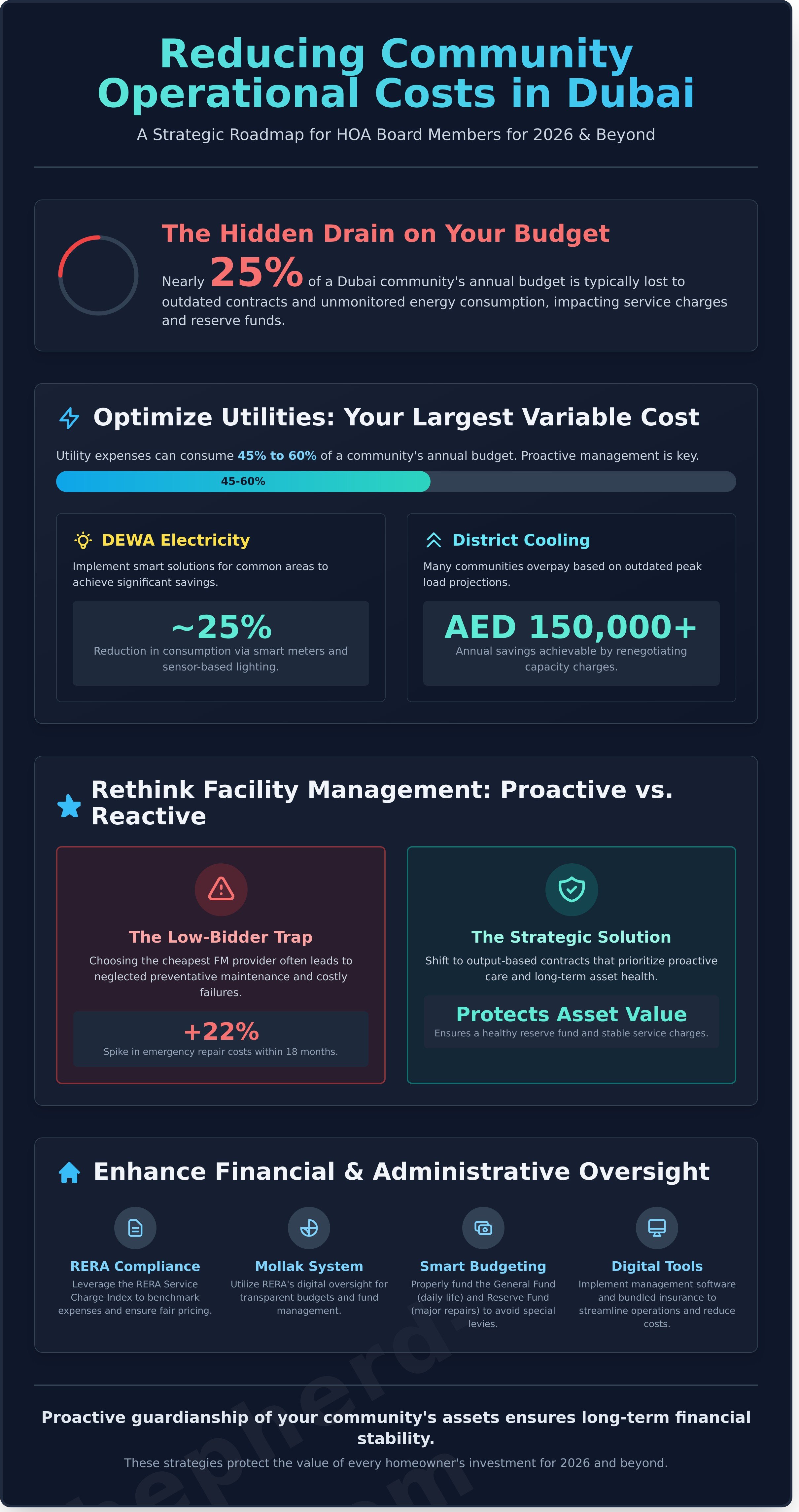
Did you know that nearly 25% of a community's annual budget in Dubai is typically lost to outdated facility management contracts and unmonitored energy consumption? As a board member, you likely feel the weight of every service charge invoice and the constant pressure from residents to lower costs without sacrificing the quality of your common areas. It's a difficult balance when DEWA rates and maintenance fees seem to climb every year, making reducing community operational costs in Dubai a top priority for every association.
We understand that your role is a volunteer one, yet the financial stakes for your neighbors are incredibly high. This guide provides a clear roadmap you can implement immediately to protect your fiduciary duty and act as a steady guardian for your community's assets. You'll discover how to audit third-party contracts for hidden inefficiencies, leverage RERA-compliant transparency to build trust, and transition toward a sustainable financial model. These steps will help you ensure a healthy reserve fund and stable service charges for 2026 and beyond.
Key Takeaways
Learn how to leverage the RERA Service Charge Index to benchmark your expenses and ensure your community remains competitively priced within the Dubai market.
Discover practical methods for optimizing DEWA consumption and renegotiating district cooling loads to significantly lower your largest variable budget items.
Master the shift toward output-based Facility Management contracts that focus on proactive, preventative care rather than costly, reactive repairs.
Implement digital management tools and bundled insurance strategies as a definitive solution for reducing community operational costs in Dubai.
Understand how proactive guardianship of your community assets ensures long-term financial stability and preserves the value of every homeowner's investment.
Table of Contents
Understanding Community Operational Costs in the 2026 Dubai Market
Optimizing Utilities: The Largest Variable in Your Budget
Strategic Facility Management (FM) Tendering
Administrative and Financial Efficiency
Partnering with Shepherd HOA for Long-Term Savings
Understanding Community Operational Costs in the 2026 Dubai Market
Managing a property in Dubai requires a clear-eyed view of where every dirham goes. Operational costs represent the total spend required to keep a development functional, safe, and attractive. These expenses primarily include facility management (FM) contracts, utility bills like DEWA or district cooling, comprehensive building insurance, and essential administrative fees. As we enter 2026, the strategy for reducing community operational costs in Dubai has shifted from simple budget cutting to sophisticated resource optimization. Real estate data from January 2026 indicates a 4.2% average increase in specialized vendor pricing, driven by rising labor costs and advanced technology requirements across the UAE.
The RERA Service Charge Index remains the gold standard for benchmarking. It prevents communities from overcharging while ensuring they remain competitive with neighboring developments in areas like Dubai Marina or Business Bay. Before diving into local specifics, it's helpful to understand the global framework of What is a Homeowner Association? to see how Dubai's Joint Owned Property laws align with international standards. This foundation helps board members realize that their challenges aren't unique, even in a highly specialized local regulatory environment.
Board members must avoid the "race to the bottom" when selecting vendors. Opting for the cheapest management or FM provider often masks hidden long-term liabilities. A 2025 study of 50 Dubai developments showed that communities choosing the lowest bidder for HVAC maintenance saw a 22% spike in emergency repair costs within 18 months. High-quality oversight acts as a protective shield for your assets. It's better to pay a fair market rate for proactive care than to face an AED 500,000 chiller replacement due to neglected preventive maintenance. Strategic investment in quality management is the most reliable path toward reducing community operational costs in Dubai over a three to five-year horizon.
The Breakdown of a Typical Dubai Service Charge
Dubai service charges are split into two distinct buckets. The General Fund is the engine of daily community life. It covers recurring costs like security, cleaning, and landscaping that keep the neighborhood running smoothly. The Reserve Fund serves as a long-term savings account for major capital expenditures, such as roof replacements or elevator overhauls. A common pitfall in budget planning is underfunding the Reserve Fund to artificially lower current fees. This mistake often leads to mid-year deficits or special levies when a major asset fails unexpectedly, causing friction among homeowners and destabilizing property values.
Regulatory Oversight: RERA and Mollak Compliance
Transparency is non-negotiable in the 2026 market. The Mollak system ensures that every budget is scrutinized and approved by RERA before a single invoice is issued to owners. This digital oversight prevents the mismanagement of funds and ensures that all spending aligns with the community's best interests. For Owners Committee members, this creates a strict fiduciary duty. You're legally responsible for protecting the community's financial health. RERA approval is the first hurdle for any cost-saving initiative, ensuring that reductions don't compromise the building's safety or structural integrity. This regulatory framework provides a secure environment where well-managed communities can thrive.
Optimizing Utilities: The Largest Variable in Your Budget
Utility expenses typically consume 45% to 60% of a community's annual budget in the UAE. These costs aren't static obligations; they're manageable variables that respond to proactive oversight. Successfully reducing community operational costs in Dubai starts with a forensic look at DEWA bills and district cooling agreements. Many boards find that the first step toward clarity is installing smart meters. These devices provide granular data that helps identify peak usage times. Combining this data with sensor-based lighting in parking basements and stairwells can reduce common area electricity consumption by as much as 25% within the first four months of implementation.
District cooling remains a complex financial challenge for many Owners Association (OA) boards. Most communities are locked into "capacity charges" based on peak load projections made during the building's design phase. If your community's actual cooling demand is lower than the contracted capacity, you're paying for energy you don't use. Engaging a consultant to renegotiate these loads with providers like Empower or Emicool can result in savings exceeding AED 150,000 annually for mid-sized towers. For communities looking toward the future, DEWA’s Shams Dubai program offers a path to energy independence. Installing solar PV panels on clubhouse roofs or parking sheds allows you to export excess power back to the grid, effectively turning a cost center into a long-term asset that protects property values.
Energy Audits and Retrofitting
A professional energy audit is the most reliable way to protect your community’s financial health. While an audit might require an upfront investment of AED 20,000, it often identifies waste exceeding AED 75,000 per year. Following the best practices established by the Middle East Facility Management Association, boards should prioritize retrofitting older HVAC systems with Variable Frequency Drives (VFDs). These drives allow motors to adjust their speed based on actual demand rather than running at 100% capacity around the clock. When you pair this with an LED conversion for common areas, which typically carries a payback period of only 14 months, the ROI becomes undeniable. This methodical approach ensures your community management strategy remains both sustainable and fiscally responsible.
Water Management in a Desert Climate
Water is a precious commodity in Dubai, and its cost in the Mollak budget can be staggering if left unmonitored. Smart irrigation systems are a game-changer for green communities. By using soil moisture sensors and local weather data, these systems prevent overwatering during humid periods, reducing landscaping water costs by 30% on average. Boards should also explore greywater recycling for community parks, repurposing AC condensate or treated water for irrigation purposes. Hidden leaks are the silent killers of a budget. A single leaking pipe in a large swimming pool can waste 5,000 liters of water daily. Implementing a weekly acoustic leak detection schedule prevents these issues from becoming financial disasters that reflect poorly on the board during annual audits.
Strategic Facility Management (FM) Tendering
Facility management represents the largest single expenditure for most Dubai homeowner associations, often consuming 40% to 60% of the total annual budget. Achieving meaningful results in reducing community operational costs in Dubai requires a shift from traditional procurement to strategic stewardship. Many boards still rely on manpower-based contracts, where they pay for a specific number of cleaners or security guards. This model is outdated and inefficient. By 2026, leading communities are moving toward output-based contracts. This approach focuses on performance standards rather than headcounts. Instead of paying for ten cleaners, you pay for a guaranteed level of cleanliness. This incentivizes the service provider to use modern equipment and smarter schedules, often resulting in a 12% to 15% reduction in contract value without sacrificing quality.
Managing third-party vendors requires a firm hand and clear expectations. Whether you're overseeing MEP (Mechanical, Electrical, and Plumbing) technicians or security teams, every contract must include a detailed Service Level Agreement (SLA). These documents act as your protective shield, ensuring that every dirham spent translates into tangible value for the homeowners. When vendors know their performance is being tracked through objective data, the "hidden" costs of negligence and slow response times begin to disappear.
Preventative vs. Reactive Maintenance
Reactive maintenance is a budget killer in the UAE's harsh climate. Fixing a central chiller plant after a total failure in the peak of August isn't just a logistical nightmare; it's a financial one. Industry data shows that emergency repairs cost 5x more than scheduled preventative care. For instance, a proactive bearing replacement costing AED 2,500 can prevent a motor burnout that would cost AED 12,500 to rectify. Effective boards implement a 5-year asset management plan that treats the building's infrastructure as a long-term investment rather than a series of problems to solve.
Integrating Computer-Aided Facility Management (CAFM) software is essential for optimizing building operational costs and maintaining a digital log of every asset. These systems provide the transparency needed to hold technicians accountable. When a pump fails, the CAFM system shows exactly when it was last serviced and by whom. This level of oversight eliminates guesswork and ensures that preventative schedules are actually followed, extending the life of community assets by years.
The Tender Process: Finding Quality at the Right Price
An ethical and transparent tender process is the foundation of community harmony. It starts with a Scope of Work (SOW) that's so precise it leaves no room for "extra" charges or "out-of-scope" invoices. In 2026, a professional tender should include a site walk-through, a technical query period, and a weighted scoring system. You shouldn't simply pick the lowest bidder. A vendor bidding 20% below market average often masks their low price with poor labor standards or low-quality spare parts, which eventually leads to higher costs for the community.
Technical Competency: Verify the vendor's trade licenses and past performance in similar Dubai communities.
KPI-Driven Contracts: Link at least 10% of the monthly payment to specific Key Performance Indicators, such as response times for lift failures or cleanliness scores.
Financial Transparency: Require a breakdown of costs, including labor, materials, and overheads, to ensure the bid is sustainable.
This methodical approach to reducing community operational costs dubai replaces the stress of fluctuating expenses with the peace of mind that comes from professional oversight. By acting as a watchful guardian of the community's funds, the board ensures that property values are protected and service charges remain competitive.
Administrative and Financial Efficiency
Administrative overhead often acts as a silent drain on community budgets. In Dubai, many Owners Associations (OAs) find that manual processes consume up to 12% of their total annual expenditure. Transitioning to digital community management tools eliminates the need for expensive physical archives and reduces the labor hours required for basic data entry. Beyond software, insurance optimization offers a significant avenue for savings. By bundling property, public liability, and machinery breakdown coverage into a single comprehensive portfolio, boards can often secure premium discounts of up to 18% compared to standalone policies. This proactive approach to reducing community operational costs dubai residents demand ensures that every dirham is spent with purpose.
Rigorous service charge collection is another pillar of financial stability. When collection rates fall below 85%, the community often incurs interest on utility bills or faces late fees from vendors. Consistent follow-ups prevent these unnecessary costs from accumulating. Similarly, the RERA-mandated financial review doesn't have to be a source of stress or high expense. Maintaining organized, digital records throughout the year allows auditors to complete their work faster. Communities with "audit-ready" digital ledgers typically pay 20% less in professional fees than those with disorganized paper trails. This efficiency satisfies regulatory requirements while keeping more money in the community's pocket.
Leveraging Technology for Governance
Automating service charge invoicing through the Mollak system is a game-changer for modern boards. It removes human error and reduces the time management staff spend on billing by approximately 45%. Digital voting platforms and virtual meeting tools further cut costs by removing the need for physical venue rentals and printed ballot materials. Shepherd's intuitive tools simplify the Board's oversight by providing a single source of truth for all financial data. This transparency allows board members to identify budget variances instantly; it gives them the power to act before a small overspend becomes a major deficit.
Financial Health and the Reserve Fund
A professional Reserve Fund Study is a vital tool for long-term financial health. This study provides a 10-year roadmap for major capital repairs, which helps the board avoid "Special Levies" that can cost individual homeowners upwards of AED 50,000 in a single payment. Following the updated RERA guidelines for 2026, boards are encouraged to explore low-risk, Sharia-compliant investment vehicles for surplus community funds to hedge against inflation. A healthy reserve fund protects property resale value. It signals to potential buyers that the building is managed with foresight and care. By focusing on these high-level financial strategies, boards can ensure the community remains a premium asset for years to come.
Ready to bring professional-grade clarity to your community's budget? [Explore how Shepherd HOA can streamline your community's financial oversight](https://shepherd-hoa.com) and help you reclaim control over your operational expenses.
Partnering with Shepherd HOA for Long-Term Savings
Achieving financial stability for your community requires more than just cutting line items. It demands a proactive guardian who understands the nuances of the local market. At Shepherd HomeOwners' Association, we act as the watchful protectors of your community's assets. We focus on **reducing community operational costs, **which Dubai residents expect to see reflected in their annual service charge statements. Our approach moves beyond reactive maintenance; we anticipate needs before they become expensive repairs.
Our track record speaks for itself. We've helped dozens of Dubai homeowners' associations reclaim their budgets by identifying hidden inefficiencies. We don't just manage; we optimize. By treating every community as if it were our own, we instill a sense of organized control that replaces the typical stress of board membership. You get the peace of mind that comes from knowing your fiduciary duties are being met with the highest level of professional oversight.
The transition to our management is designed to be seamless. Many boards hesitate to switch because they fear administrative chaos. We've solved this. Our digital onboarding protocol ensures all historical data, financial records, and maintenance logs move into our system within 14 business days. This allows for a stress-free handover that prioritizes **reducing community operational costs, **which Dubai boards struggle with during management gaps. We handle the heavy lifting so you can focus on making high-level decisions for your neighbors.
Why Expertise Matters in Cost Reduction
Navigating the Dubai real estate landscape requires specialized knowledge of local regulations. We maintain deep, long-standing relationships with over 65 RERA-approved vendors. This network allows us to secure competitive bidding that individual boards often cannot access. Because we understand the Mollak system inside and out, we accelerate budget approvals and ensure service charge filings are accurate the first time. This prevents the costly delays and fines that often plague less experienced management firms.
Consider our work with a prominent high-rise tower in Dubai Marina in late 2023. The community was struggling with aging HVAC systems and inflated utility bills. Our team conducted a comprehensive audit and renegotiated three major facility management contracts. By implementing energy-efficient lighting and optimizing the cooling schedule, we achieved a 15% reduction in service charges within 12 months. This intervention saved the community over AED 420,000 annually, which was immediately redirected into their long-term reserve fund.
Take Control of Your Community’s Future
Your community deserves a management partner that values transparency and integrity. Our RERA-certified managers are ready to help you identify immediate savings opportunities through a comprehensive budget health check. We provide the technical mechanism to turn your financial goals into reality without the typical administrative headaches. It's time to move your community toward a more stable and harmonious future.
Schedule a one-on-one consultation with our expert management team.
Download our 2026 Community Budget Planning Template to start organizing your vision.
Request a detailed audit of your current vendor contracts to find immediate AED savings. We are ready to serve as the steady guide your board needs. Let Shepherd HomeOwners' Association guide your community toward financial harmony and ensure your property values remain protected for years to come.
Take Control of Your Community’s Financial Health
Managing a Dubai homeowners association in 2026 requires more than just oversight; it demands a proactive strategy to protect property values and maintain community harmony. By focusing on utility optimization and competitive FM tendering, boards move away from reactive spending toward a model of sustainable growth. Implementing these efficiencies isn't just about saving AED; it's about fulfilling your fiduciary duty to every homeowner who trusts your leadership. Clear, data-driven decisions ensure your neighborhood remains a desirable place to live for years to come.
Shepherd HOA acts as your expert guide through this complex landscape. As a RERA-approved management company, we specialize in reducing community operational costs in Dubai by 10% to 15% through expert Mollak system integration and streamlined administrative oversight. We've designed our approach to replace board member stress with organized control, ensuring every dirham is accounted for and every service provider meets the highest standards. You don't have to navigate these regulatory and financial challenges alone.
Ready to see where your budget can work harder? Request a Professional Community Budget Audit from Shepherd HOA today. Let’s build a more resilient and cost-effective future for your neighborhood together.
Frequently Asked Questions
How often can an HOA Board in Dubai review and change service charges?
HOA Boards review and update service charges once per year during the annual budget preparation cycle. Every proposed budget must undergo a rigorous audit by a RERA-approved firm before it's uploaded to the Mollak system for final government approval. While the board sets the financial direction, RERA ensures fees remain fair and aligned with the property's actual maintenance requirements.
Can we reduce the Reserve Fund contribution to lower immediate costs?
You can't arbitrarily lower Reserve Fund contributions because RERA mandates a specific allocation, typically between 10% and 15% of the total budget, to protect the building's long-term health. A formal Reserve Fund Study must be conducted every 3 years by a certified specialist to determine the exact requirements. Cutting these funds now is a risk that leads to emergency levies of AED 5,000 or more per owner when major assets like elevators or chillers fail.
What are the most common hidden costs in Dubai facility management contracts?
Hidden costs often appear as "out-of-scope" labor charges and high markups on HVAC consumables, which can inflate a budget by 18% annually. Many boards in Dubai succeed in reducing community operational costs by negotiating comprehensive contracts that include a cap on spare parts at AED 1,000 per instance. This prevents the common trap of paying AED 200 call-out fees for minor repairs that should be covered under standard preventive maintenance.
Does RERA allow communities to implement solar power to save on DEWA?
RERA and DEWA fully support the adoption of solar energy through the Shams Dubai initiative launched in 2015. Communities can install photovoltaic panels to power common areas, potentially slashing electricity bills, which often represent 40% of total operational spending. To start, the board needs a technical feasibility study and a No Objection Certificate from the developer to ensure the installation meets safety and aesthetic standards.
How does the Mollak system prevent management companies from overcharging?
The Mollak system acts as a digital guardian by requiring 100% transparency for every dirham spent within the community. Management companies must submit detailed invoices and bank reconciliations that RERA officials verify before any service charge is issued to owners. This centralized oversight prevents unauthorized spending and ensures that management fees stay within the pre-approved limits set during the annual budget filing.
What happens if a community has a budget deficit at the end of the year?
If a community faces a deficit, the board must address the shortfall in the next fiscal year's budget submission to RERA. This usually results in a slight adjustment to the following year's service charges to replenish the accounts. We recommend maintaining a 5% contingency fund to act as a financial buffer against unexpected utility price hikes or emergency structural repairs that occur outside the standard maintenance schedule.
How can we encourage residents to pay service charges on time to reduce costs?
Timely payments are essential because they eliminate the need for legal notices and debt collection services that can cost the association AED 2,500 per case. Boards should use the Mollak portal to send automated payment reminders and offer structured payment plans for owners in documented financial difficulty. Showing owners exactly how their AED 12 per square foot contribution maintains property value helps foster a culture of shared responsibility.
Is it possible to switch community management companies mid-contract in Dubai?
You can change your management provider mid-contract by providing a 90-day written notice and securing formal approval from RERA. The board must demonstrate that the current company hasn't met its fiduciary duties or that a new provider offers a more efficient path to community harmony. A structured handover process is vital to ensure that all digital records, maintenance logs, and financial assets are transferred securely without disrupting daily operations.


Comments