
Reserve Fund vs General Fund in Dubai: The 2026 Homeowner's Financial Guide
- Sohrab Virani

- Jul 21
- 11 min read
What if your annual service fee wasn't actually an expense, but a strategic insurance policy for your property's future resale value? Most homeowners in Dubai feel a pinch of frustration when the Mollak invoice arrives, often wondering why their hard-earned money is split into different categories. It's common to feel overcharged or worried that a "special levy" for an emergency repair might suddenly appear. Understanding the mechanics of the reserve fund vs general fund dubai is the first step toward replacing that operational stress with a sense of organized control.
You deserve to know that your community funds are being managed with integrity and transparency. We promise to clarify the critical differences between these two accounts, helping you ensure your investment remains protected and fully RERA-compliant. This guide provides a methodical breakdown of operational spending versus capital preservation, giving you the confidence that your property's financial backbone is secure and your asset value is being watched over with professional care.
Table of Contents
The Dual-Fund Structure: Why Dubai Communities Use Two Separate Accounts
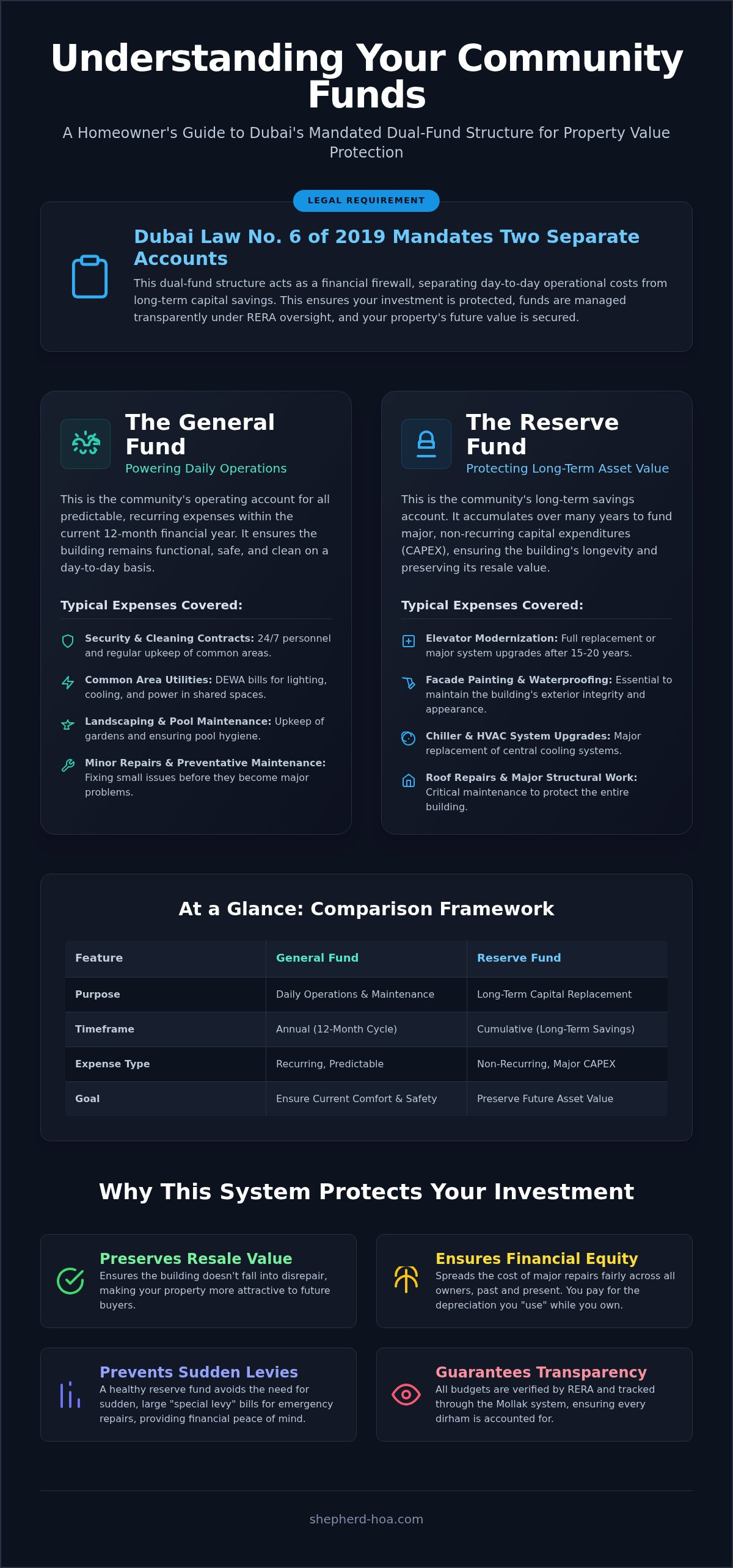
Managing a community's finances requires a disciplined approach to ensure both immediate comfort and long-term stability. In Dubai, this discipline is legally mandated through a dual-fund structure. This framework requires a clear separation of capital into two distinct pools, ensuring that the funds needed for today don't compromise the safety of your investment tomorrow. Understanding the mechanics of the reserve fund vs general fund dubai is essential for any homeowner who wants to protect their property's value.
Think of this separation as a financial firewall. The General Fund handles the community's immediate, day-to-day survival, while the Reserve Fund acts as a long-term savings account. This structure ensures that daily bills never "eat" the money intended for significant future works. Without this division, a community might find its savings depleted by routine maintenance, leaving nothing for critical upgrades when they're most needed. This dual-account system creates a transparent environment where every dirham has a specific, RERA-approved purpose.
The General Fund typically covers recurring operational costs, including:
Utility bills for common areas (DEWA)
Security and cleaning service contracts
Landscaping and swimming pool maintenance
Minor repairs and management fees
Conversely, the Reserve Fund is dedicated to non-recurring capital expenditures (CAPEX), such as:
Elevator modernization or full replacement
Facade painting and waterproofing
Chiller and HVAC system upgrades
Roof repairs and major structural maintenance
The Legal Basis: Dubai Strata Law and RERA
Dubai Law No. 6 of 2019, which governs jointly owned property, provides the legal foundation for these accounts. The Real Estate Regulatory Agency (RERA) acts as the primary authority for budget oversight, ensuring that every community maintains these distinct pools to remain compliant. This regulatory framework is designed to prevent the mismanagement of owner contributions and ensure that every building in Dubai remains sustainable over the long term. Professional managers act as guardians of these funds, ensuring every budget is uploaded to the Mollak system for government verification.
The Concept of 'Fair Allocation' for Owners
Beyond legal compliance, the dual-fund system ensures financial equity. It prevents a scenario where a new buyer pays for ten years of past wear and tear. By contributing to a reserve fund, every owner pays for the specific "utility" or depreciation they consume while they own the property. This spreads the cost of major repairs fairly across all owners, past and present. It protects your resale value by ensuring the building doesn't fall into disrepair due to a lack of available capital, providing peace of mind for both current residents and future investors.
The General Fund: Powering Daily Operations and Maintenance
The General Fund represents the heartbeat of your community's daily existence. It's the financial engine that covers every recurring expense required to keep the building functional, safe, and comfortable within the current 12-month financial cycle. When you receive your annual invoice, the primary portion of your payment is allocated here to ensure the lights stay on and the common areas remain pristine. In the framework of reserve fund vs general fund dubai, the General Fund is strictly for immediate consumption rather than long-term accumulation.
Transparency is the cornerstone of this account's management. Every dirham collected and spent is tracked through the Mollak Dubai system. This government-mandated platform provides a clear window into the community's financial health, allowing homeowners to verify that their contributions are paying for essential services like DEWA bills for common areas, 24/7 security teams, and professional cleaning crews. By utilizing this system, we ensure that community funds are handled with the highest level of accountability, replacing administrative stress with organized control.
Common General Fund Expenses
Operational costs are predictable but relentless. Your General Fund is the resource that powers the ongoing lifestyle standards of your building. This includes:
Preventative maintenance for HVAC, plumbing, and electrical systems to stop minor issues from becoming major failures.
Landscaping, pool chemical treatments, and the regular upkeep of gym equipment.
Mandatory insurance premiums that protect the building structure and common areas from unforeseen liabilities.
Waste management services and pest control for all shared spaces.
Managing the Operational Budget
Effective management isn't just about paying bills; it's about strategic optimization. Shepherd HOA acts as a watchful guardian to refine community service charge budgets in Dubai by focusing on efficiency and value. We utilize ethical tendering for third-party contracts, which means we invite multiple vetted contractors to bid on services. This process eliminates the risk of inflated costs and ensures that homeowners aren't overcharged for basic maintenance. It's a definitive solution to the common pain point of feeling like service fees are too high without justification.
A healthy General Fund prevents the anxiety of budget deficits. If this fund runs dry, it's often a sign of poor planning or low collection rates, which can lead to service interruptions or emergency collection requests. We prioritize rigorous financial oversight to ensure the fund remains balanced. If you're looking for a partner to bring this level of integrity to your building, our budget planning expertise ensures your community stays operational and financially sound throughout the year.
The Reserve Fund: Protecting Long-Term Asset Value
While the General Fund keeps the building alive today, the Reserve Fund ensures it thrives for decades. This account is dedicated strictly to non-recurring capital expenditures (CAPEX) that fall outside the standard annual maintenance cycle. We view this fund as the financial guardian of your property's future. It covers items with a lifespan of more than 12 months, ensuring that the building's infrastructure remains modern and safe without placing an undue burden on current residents. The Reserve Fund is a depreciation-offsetting savings plan designed to accumulate capital over time to meet the future costs of major asset replacements.
A healthy fund is your primary defense against "Special Levies." These are emergency cash calls where homeowners are suddenly asked to contribute large sums because the community lacks the capital for a critical repair. When you analyze the reserve fund vs general fund dubai, the most significant benefit of a well-maintained reserve is the elimination of these financial shocks. It transforms massive, unpredictable expenses into manageable, predictable contributions. This proactive approach replaces operational stress with a sense of organized control, knowing that the building's "invisible backbone" is financially secure.
Typical Reserve Fund Projects
Reserve funds are reserved for high-impact projects that preserve the structural integrity and aesthetic appeal of the community. These aren't routine fixes but major investments that directly influence property resale value. Typical projects include:
Full elevator modernization or complete replacement of mechanical components.
External facade repainting or refurbishment of cladding to maintain the building's "curb appeal."
Major structural repairs, including roof waterproofing and the overhaul of central chiller systems.
The Reserve Fund Study (RFS)
To ensure the fund remains accurate, RERA mandates a formal Reserve Fund Study (RFS) every 3 to 5 years. This isn't a simple estimate; it's a technical audit performed by chartered surveyors who calculate the "useful life" and "replacement cost" of every major component in the building. These experts use financial modeling to ensure the fund grows at the correct pace to meet 2026 costs for labor and materials. This methodical oversight is a core part of how we manage the reserve fund vs general fund dubai balance, ensuring that current owners aren't underpaying and future owners aren't left with a crumbling asset. It's a definitive solution for long-term asset preservation that provides peace of mind to every investor.
General Fund vs. Reserve Fund: A Comparison Framework
To master your community's finances, you must view these two accounts through different lenses of time and purpose. The General Fund operates on a "use it or lose it" principle. It's designed to meet the immediate needs of the community within the current 12-month financial year. Conversely, the Reserve Fund is cumulative. It's a long-term vehicle that builds value over decades, often earning interest that stays within the fund to combat inflation and the rising costs of construction materials. Understanding the reserve fund vs general fund dubai distinction allows you to see your service charge not as a single fee, but as two distinct layers of protection.
Transparency is no longer a luxury for Dubai homeowners; it's a digital reality. Every owner can now track the health of both funds through their personal Mollak dashboard. This platform provides real-time visibility into how RERA has determined the split in your service charge. This allocation isn't arbitrary. It's based on the specific age of your building and the technical requirements identified in the most recent professional study. This data-driven approach ensures that your community is never underfunded or overcharged.
Key Differences at a Glance
The frequency of spending is the most visible differentiator between these accounts. General Fund capital flows out predictably on a monthly or annual basis to cover operational contracts like security and cleaning. The Reserve Fund might remain untouched for years, quietly accumulating capital for a major event that may only occur every 15 to 25 years. Their approval paths also diverge. While the general budget requires an annual RERA review for operational relevance, Reserve Fund contributions are anchored in the long-term projections of a technical lifecycle study.
Why You Can't Transfer Money Between Funds
Dubai's regulatory framework utilizes strict "ring-fencing" rules to prevent financial mismanagement. It's a legal violation to transfer money from the Reserve Fund to cover an operational deficit in the General Fund. This protection acts as a safeguard, ensuring that the capital saved for a critical elevator replacement isn't accidentally depleted by an unexpected utility bill. Maintaining these boundaries is a core responsibility of expert Owners Association Management in Dubai. This professional oversight ensures that the community remains compliant with RERA's financial standards while protecting the long-term interests of all homeowners.
If you want to ensure your community's funds are managed with this level of RERA-compliant integrity, partner with Shepherd HOA for expert financial guardianship and budget planning.
How Professional Management Secures Your Community's Future
Professional management acts as the watchful guardian of your community's financial health. It isn't just about collecting fees; it's about the sophisticated oversight of capital to ensure long-term asset preservation. When a management firm maintains a clear distinction between the reserve fund vs general fund dubai, they protect your property from the "building decay" that often leads to plummeting resale prices. Buyers in 2026 are more educated than ever. They look for communities with healthy, transparently managed funds because these buildings represent lower risk and higher liquidity.
Trust is built through accurate financial reporting. Shepherd HOA ensures that every budget and expenditure meets the strict RERA Dubai standards for jointly owned property. By utilizing the Mollak system for all financial disclosures, we provide a definitive solution to the confusion and stress often associated with service charges. This organized control ensures that your investment isn't just a place to live, but a growing financial asset protected by expert guardianship.
The Shepherd Approach to Budgeting
Our strategy goes beyond simple accounting. We utilize data-driven forecasting to inform the Reserve Fund Study, ensuring that every dirham saved today is ready for the costs of tomorrow. We provide transparent reporting directly to the Owners' Committee, giving you a clear window into the fund's health at all times. By focusing on proactive maintenance, we extend the useful life of the building's infrastructure. This practical approach saves significant money in the Reserve Fund by delaying the need for expensive full-scale replacements, directly benefiting your bottom line.
Your Next Steps as an Owner
Taking control of your investment starts with understanding the paperwork. We recommend that every homeowner takes these three steps to ensure their community is on the right track:
Review your next service charge invoice specifically to see the split between the General and Reserve funds.
Ask your management company for a copy of the latest Reserve Fund Study to see if the building's long-term needs are being met.
Verify that all community financial reports are being updated regularly in the Mollak system for full RERA compliance.
If you're concerned about the management of your community's assets, it's time to seek a partner who values integrity and transparency above all else. You can contact Shepherd HOA for expert community financial management to ensure your property remains a secure, high-value investment for years to come.
Protecting Your Asset Through Strategic Financial Oversight
Protecting your property investment requires more than just paying annual fees; it demands an understanding of how your capital is distributed. By mastering the distinction between the reserve fund vs general fund dubai, you move from a place of uncertainty to one of organized control. You've seen how the General Fund ensures daily operational survival while the Reserve Fund acts as a protective shield for your asset's long-term resale value. This transparent, dual-account structure is the backbone of a resilient and harmonious community.
Since 2010, Shepherd HOA has served as a steady guide for Dubai homeowners, offering deep UAE expertise and a commitment to transparency. Our RERA-approved community management and expert Mollak financial reporting ensure your budgets are always compliant and your assets are guarded with integrity. We replace the stress of administrative oversight with the peace of mind that comes from professional guardianship. It's time to take the next step toward financial stability and long-term asset preservation.
Secure your community's financial future with Shepherd HOA and ensure your property remains a source of pride and value for years to come.
Frequently Asked Questions
Is the reserve fund contribution mandatory in Dubai?
Yes, contributing to a reserve fund is a legal requirement under Dubai Law No. 6 of 2019. This legislation mandates that every jointly owned property maintains a financial cushion for future capital works. RERA enforces this rule to protect the structural integrity of buildings across the city and to prevent financial instability within residential and commercial communities.
Can the Owners' Committee decide to stop reserve fund collections?
No, the Owners' Committee doesn't have the authority to halt these collections. Since these funds are part of a RERA-approved budget, they must be collected according to the legally sanctioned schedule. Any adjustment to the contribution levels would require a new professional technical study and subsequent government approval to ensure the building's long-term health isn't compromised.
What happens if the reserve fund is empty when a major repair is needed?
If the fund is insufficient for a critical repair, the management may be forced to issue a "Special Levy" to all homeowners. This is an emergency request for immediate additional capital to cover the shortfall. Maintaining a healthy balance in the reserve fund vs general fund dubai avoids these stressful financial shocks and ensures major works like chiller replacements proceed without delay.
How do I see how much money is currently in my community's reserve fund?
You can view your community's fund balances directly through the Dubai Land Department's "DLD Vault" service or your personal Mollak dashboard. These digital platforms provide transparent access to RERA-approved budgets and the latest audited financial statements. If you're unsure how to navigate these tools, your community manager can provide a guided walkthrough of the most recent financial reports.
Does a higher reserve fund make my property harder to sell?
Actually, a well-funded reserve usually makes a property more attractive to buyers. Savvy investors and mortgage lenders view a healthy reserve as a sign of a well-managed building with low risk of future emergency costs. It signals that the community is prepared for major maintenance, which protects the buyer's future resale value and ensures long-term property liquidity.
Who owns the money in the reserve fund if I sell my apartment?
The money stays with the property unit and remains in the community's collective account. When you sell your apartment, your past contributions aren't refunded because they were paid for the depreciation that occurred during your period of ownership. The new owner then takes over the responsibility for future contributions, benefiting from the financial stability you helped build during your tenure.
How often should a Reserve Fund Study be conducted under RERA rules?
RERA guidelines typically require a formal Reserve Fund Study to be conducted every 3 to 5 years. This technical audit, performed by chartered surveyors, ensures that the collection rates remain aligned with the actual condition of the building and current market costs. Regular updates prevent the fund from falling behind inflation or the rising costs of specialized labor and materials.
Can reserve funds be used for aesthetic upgrades or only repairs?
Reserve funds are primarily dedicated to the replacement or major repair of existing assets rather than purely decorative changes. While a facade repainting is covered because it preserves the building's structure, installing entirely new luxury features might require a separate budget approval. Understanding the reserve fund vs general fund dubai balance helps owners see that these funds are specifically for essential asset preservation.


Comments