
Common Defects in New Buildings UAE: Protecting Your 2026 Investment
- Sohrab Virani

- 3 days ago
- 12 min read
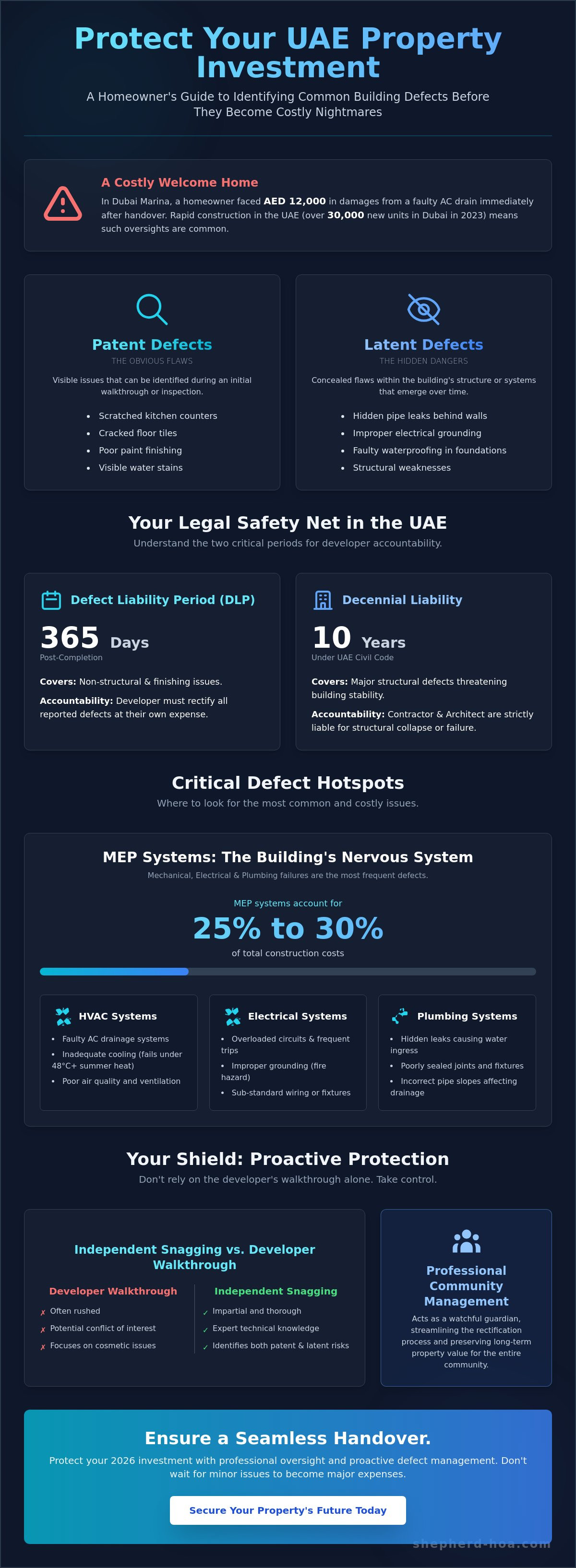
In January 2024, a homeowner in Dubai Marina received their keys only to discover that a faulty AC drainage system had already caused AED 12,000 in damage to the internal masonry. This scenario highlights why spotting common defects in new buildings uae is a vital step in protecting your 2026 investment. You've likely spent months anticipating your handover, and it's natural to feel a mix of excitement and anxiety about the hidden structural or MEP issues that might lie behind fresh paint.
We understand that the Defect Liability Period (DLP) often brings more questions than answers regarding developer accountability and long-term maintenance. This article identifies the critical construction flaws you need to recognize before they diminish your property value. You'll learn how professional oversight simplifies the handover process and provides the organized control you need for a seamless transition. We'll examine the technical standards for UAE developments and provide a clear roadmap to ensure your community remains a secure, high-value asset for years to come.
Key Takeaways
Learn how to distinguish between patent and latent flaws to ensure your investment remains protected throughout the mandatory Defect Liability Period.
Identify the most common defects in new buildings uae, specifically regarding MEP systems that must withstand the region’s intense summer climate.
Discover why independent third-party snagging inspections provide a superior level of protection compared to standard developer-led walkthroughs.
Understand the critical link between minor cosmetic finishes and the overall structural integrity of your new property.
See how professional community management serves as a watchful guardian, streamlining the rectification process to preserve long-term property value.
Table of Contents Understanding Common Defects in New UAE Buildings Critical Technical Defects: MEP and Structural Systems Finishing and Cosmetic Defects: More Than Just Aesthetics The Inspection and Snagging Process: A Homeowner’s Shield How Professional Community Management Protects Your Investment
Understanding Common Defects in New UAE Buildings
Buying property in the Emirates is a significant milestone, yet the transition from handover to habitation often reveals unexpected challenges. In the context of UAE construction standards, building defects refer to any work that falls short of the agreed specifications or national safety codes. These issues often stem from the intense pressure to meet handover deadlines in a market that saw over 30,000 new units delivered in Dubai alone during 2023. This rapid pace frequently leads to oversights in finishing and MEP (mechanical, electrical, and plumbing) systems.
Homeowners must distinguish between patent defects, which are visible during the initial walkthrough, and Latent Defects that remain hidden within the building's envelope. While a scratched kitchen counter is a visible annoyance, a hidden pipe leak behind a bathroom wall can cause thousands of AED in damage before it's discovered. Addressing these common defects in new buildings uae early is the only way to prevent community friction and avoid sudden spikes in service charges that occur when the association must cover repairs out of pocket.
The emotional stakes are just as high as the financial ones. When residents move into a luxury development only to find failing air conditioning or water ingress, the sense of organized control vanishes. This stress often boils over into board meetings, making the management of the community significantly more difficult for volunteer members.
The Legal Framework: DLP and Developer Accountability
The UAE Civil Code provides a clear safety net for owners through two distinct layers of protection. For the first 365 days after completion, the Defect Liability Period (DLP) requires developers to rectify non-structural issues at their own expense. For more serious concerns, Articles 880 to 883 of the Civil Code establish a 10-year decennial liability period. This law holds contractors and architects strictly accountable for any structural collapse or major defects that threaten the building's stability. Identifying common defects in new buildings uae within these windows is vital for successful mediation through the Dubai Land Department or RERA.
Fiduciary Duty: Why HOA Boards Must Prioritize Snagging
When a board ignores common area defects, they're essentially spending the community's future savings today. Identifying issues in lobbies, gyms, and mechanical rooms ensures the developer pays for repairs rather than the owners' reserve fund. This oversight is a core component of the board’s role as a guardian of the neighborhood’s assets.
Fiduciary duty in building maintenance is the legal and ethical obligation of board members to preserve property value through proactive defect identification and financial oversight.
By acting decisively during the first year of a building's life, boards prevent the premature depletion of funds. This proactive approach keeps service charges stable and maintains the long-term prestige of the development, ensuring that the 2026 investment remains a source of pride rather than a financial burden.
Critical Technical Defects: MEP and Structural Systems
Mechanical, Electrical, and Plumbing (MEP) systems represent the nervous system of any modern tower in Dubai or Abu Dhabi. These components account for approximately 25% to 30% of total construction costs. They also happen to be the source of the most common defects in new buildings uae residents face today. When these systems fail, the financial impact isn't just limited to repair costs; it affects the long-term valuation of your 2026 investment. Owners must distinguish between minor aesthetic settling and genuine foundational risks. Under the UAE Decennial Liability Law, developers remain responsible for the structural integrity of the building for a full decade. This legal framework provides a safety net for major failures in reinforced concrete, such as deep diagonal cracks that indicate ground movement rather than simple plaster shrinkage.
Electrical faults present a more immediate danger. Overloaded circuits and improper grounding often stay hidden behind pristine finishes until the first peak summer load. Inadequate circuit labeling or the use of sub-standard wiring can lead to frequent breaker trips or, in extreme cases, electrical fires. Ensuring your community has organized administrative oversight helps track these recurring maintenance logs to identify systemic developer errors before warranties expire.
HVAC Failures and Air Quality Issues
The UAE's extreme climate, where summer temperatures regularly exceed 48°C, acts as a brutal stress test for cooling systems. Common HVAC snags include poor duct insulation and refrigerant leaks that force compressors to work at 120% capacity. This inefficiency drives up DEWA or ADDC bills significantly. Improper ventilation also triggers "sick building syndrome," where stagnant air and high humidity levels create a breeding ground for mold. You'll often find this growth hidden behind gypsum partitions, caused by condensation from poorly wrapped AC pipes.
Plumbing and Waterproofing Breaches
Water damage is the most persistent threat to high-rise living. Inconsistent water pressure often plagues the upper floors of new developments, leading to pump failure and pipe bursts. Waterproofing failures in "wet areas" like balconies and laundry rooms usually stem from rushed membrane application during the construction phase. Professional inspectors now use thermal imaging cameras to detect these moisture ingress points. This technology reveals cold spots behind tiles that the naked eye cannot see, preventing a small leak from becoming a structural nightmare that costs thousands of AED to remediate.
Finishing and Cosmetic Defects: More Than Just Aesthetics
A scratch on a skirting board or a misaligned cabinet door might seem like a minor grievance. However, these common defects in new buildings uae often serve as the first warning sign of a breakdown in quality control. When a developer fails to oversee the final touches, it's a strong indicator that more critical, hidden systems may have been rushed. For investors looking toward 2026, these aesthetic flaws can quickly erode the premium feel of a property and decrease its rental yield.
Poor finishing disrupts the harmony of a community. It creates a sense of neglect that affects resident satisfaction and long-term property value. We frequently observe specific issues that compromise a home's integrity:
Tiling Failures: Hollow sounds when tapped indicate poor adhesive application. Uneven lippage, where tile edges aren't flush, creates trip hazards and makes floor maintenance difficult.
Grout Degradation: Failing grout lines allow moisture to seep into subfloors. This leads to mold growth and eventual tile lifting.
Joinery and Cabinetry: Misaligned doors and poor laminate bonding are frequent issues. Hardware failures in hinges or drawer slides often occur within the first six months of occupancy if low-grade components were used.
Wall and Ceiling Imperfections
Wall defects often manifest as "ghosting," where internal framing or fasteners become visible through the paint. Poor paint coverage and uneven plastering are also prevalent in high-volume developments. It's vital to distinguish between natural building shrinkage and poor workmanship. While hairline cracks are expected as a structure settles, sagging gypsum boards or visible joints in common area ceilings suggest structural movement or improper installation of the suspension system. These issues require immediate rectification to prevent larger sections from failing.
External Building Envelope Issues
The external appearance of a building is its primary asset for curb appeal. Defects in cladding, glazing, and external paint don't just look bad; they expose the building to the elements. During the shamal season, window seal failures lead to significant dust ingress and energy loss, driving up cooling costs for residents. Our oversight often identifies failures in common area pathways and landscaping irrigation systems. If these external elements aren't maintained, they can lead to water pooling and damage to the building's foundation, undermining the stability of the entire community.
The Inspection and Snagging Process: A Homeowner’s Shield
A professional building inspection functions as a critical safety net for your investment. The process follows a top-down logic, beginning with the roof's waterproofing and drainage systems before moving through the building's facade and into the basement's structural foundations. This methodical approach ensures that no system, from the heavy-duty MEP plant rooms to the smallest electrical socket, escapes scrutiny. While developers often provide a brief walkthrough, an independent third-party inspection is superior because it removes the conflict of interest. These experts work for you, identifying common defects in new buildings uae that internal teams might minimize to accelerate handover schedules.
Modern inspections in 2026 rely on high-precision technology rather than just the naked eye. Professionals use FLIR thermal imaging cameras to detect insulation gaps or hidden AC leaks that lead to mold. Moisture meters identify dampness behind expensive marble cladding, while digital laser levels verify if floor gradients meet the 3mm tolerance standard. Documenting these findings with high-resolution photos and technical descriptions creates a "snag list" that the developer cannot easily dispute. This documentation forces accountability, ensuring repairs happen before you sign the final handover certificate.
Preparing for the Handover Inspection
Success starts with organization. You must have your original floor plans, the Sales and Purchase Agreement (SPA), and MEP shop drawings ready for the inspector. Schedule the appointment between 10:00 AM and 2:00 PM when natural sunlight is at its peak; this makes it much easier to spot hairline cracks or paint inconsistencies. For a deeper look at the administrative requirements, you can review our guide on the property handover process in Dubai. Having these documents ensures the inspector can verify that the delivered unit matches the promised specifications.
Reviewing the Snagging Report
The resulting report often contains dozens of items, so you must prioritize them effectively. Focus on "critical" defects like faulty wiring or plumbing leaks first, as these impact safety and habitability. "Cosmetic" issues, such as minor scratches on cabinetry, are secondary but still require rectification. Once the developer claims repairs are finished, a re-inspection is mandatory to verify the quality of the work. A professional snagging report is a legal necessity for HOAs because it provides the documented evidence required to enforce the 10-year structural warranty under UAE law. By acting as a watchful guardian of your property's condition, you protect the community's long-term value from day one.
Ready to secure your property's future? Partner with Shepherd HOA to streamline your community management and oversight.
How Professional Community Management Protects Your Investment
Shepherd HOA acts as a protective shield during the critical first 24 months of a building's life. This post-handover period is often chaotic, filled with snagging lists and technical disputes. Our approach involves "shepherding" the Owners Association (OA) through these complexities to ensure that common areas meet the promised standards. Addressing common defects in new buildings uae early prevents long-term financial strain on the community's budget.
Large-scale defect rectification requires a central coordinator. When issues appear in common areas, such as façade leaks or HVAC failures, the community manager bridges the gap between the developer and the technical teams. We leverage the Mollak system to provide total financial transparency. This ensures that repair cycles are funded correctly and that developers fulfill their liability periods without draining the community's reserve fund. Every dirham spent is tracked and justified through official regulatory channels.
Professional oversight stops the cycle of finger-pointing. Developers often claim poor maintenance caused a failure, while facility managers blame poor construction. We provide the documentation and technical evidence needed to resolve these disputes quickly. This organized control saves the community thousands of AED in potential legal fees or unnecessary repair costs that should rightfully be covered by the builder.
Managing the Developer Relationship
We maintain a firm, expert stance when dealing with developers. It's about contractual accountability rather than confrontation. Our deep knowledge of RERA compliance for communities allows us to cite specific regulations that protect owner interests. We also ensure all community warranties are accurately transferred and digitized. If a component fails three years later, we have the record ready to trigger a warranty claim immediately, ensuring the developer honors their 10-year structural obligations.
Long-term Asset Protection and Harmony
A well-managed building retains its value over decades. Proactive management of common defects in new buildings uae prevents small issues from escalating into major capital expenditures. This results in stable service charges and higher property appreciation for investors. We act as the watchful guardian of your building's health, allowing board members to focus on their lives while we handle the technicalities. Ensure your community is protected with Shepherd HOA’s expert management and gain the peace of mind you deserve.
Take Control of Your Property's Long-Term Value Today
Identifying common defects in new buildings uae represents the first line of defense for your 2026 investment. Whether you're dealing with complex MEP systems or minor cosmetic snags, these issues require immediate attention before the developer's liability period expires. Shepherd HOA provides the steady guidance needed to navigate this transition period. We leverage decades of experience in UAE property handover and governance to protect your community's interests. Our team ensures full alignment with RERA and Mollak compliance systems; this removes the administrative burden from your board members. We're dedicated to preserving property value through ethical oversight and proactive maintenance strategies. By choosing a partner that understands the specific challenges of the Emirates market, you ensure your neighborhood remains a premier destination for years to come. Secure your building’s future with Shepherd HOA’s professional community management. Your peace of mind is our highest priority as we safeguard the home you've built.
Frequently Asked Questions
What is the Defect Liability Period (DLP) for new buildings in the UAE?
The standard Defect Liability Period for non-structural issues is 365 days from the date the building receives its completion certificate. During this year, the developer is legally required to repair common defects in new buildings UAE at no additional cost to the owners. While minor issues expire after 12 months, structural integrity is protected for 10 years under the decennial liability provisions found in the UAE Civil Code.
Can I move into my property before all defects are fixed?
You can move into your property as soon as you receive the keys, but you must ensure a comprehensive snagging report is signed by the developer first. It's common for owners to occupy the unit while minor repairs are scheduled. However, documenting every issue before move-in is vital, as it prevents the developer from claiming that scratches or marks were caused by your furniture removal team.
What happens if a structural defect is found after the 1-year DLP expires?
Structural defects remain the developer's responsibility for 10 years under Article 880 of the UAE Civil Code. This long-term liability covers major issues that threaten the stability or safety of the building, such as foundation cracks or concrete cancer. You don't lose your protection just because the initial one-year maintenance period has ended; the law provides a decade of oversight for the building's core framework.
How many defects are considered "normal" for a new UAE apartment?
A professional inspection typically uncovers between 50 and 150 individual snags in a standard two-bedroom apartment. Most of these items are minor aesthetic points, such as paint overspray on skirting boards or uneven grout lines in the bathroom. While a high number of snags can feel overwhelming, it's a standard part of the construction process and doesn't necessarily indicate a low-quality building.
Is the developer required to fix cosmetic issues like paint scratches?
The developer must fix cosmetic defects if they're recorded in the formal snagging report during the handover process. Once you accept the keys and begin living in the unit, it's difficult to prove that paint chips or floor scratches weren't caused by daily wear and tear. You should be meticulous during your walkthrough to ensure all visible common defects in new buildings UAE are documented before you sign the final acceptance form.
What should I do if the developer refuses to acknowledge a major defect?
If a developer ignores your requests for essential repairs, you should escalate the matter to the Dubai Land Department (DLD) or the relevant regulatory authority in your Emirate. Provide copies of your original inspection reports and all written correspondence to show the developer's lack of action. Under Law No. 6 of 2019, regulators have the power to intervene and ensure developers fulfill their maintenance obligations to homeowners.
How does a community management company help with building defects?
A community management company acts as a professional guardian for the HOA board by managing the rectification process for shared facilities. They coordinate technical audits of the building's plant rooms, elevators, and swimming pools to identify systemic failures before the warranty expires. This expert oversight ensures that the developer doesn't hand over a building with hidden liabilities that could drain the community's budget later.
Can the HOA board use the reserve fund to fix developer defects?
The HOA board shouldn't use the reserve fund to pay for repairs that fall under the developer's warranty or decennial liability. Reserve funds are strictly earmarked for the long-term replacement of assets, like roof membranes or chiller units, after their natural lifespan ends. Using these funds for developer mistakes can lead to a 25% budget deficit, eventually forcing the board to issue a special levy to all homeowners.


Comments