
How to Run an Effective Owners Association Meeting in 2026: A Board Member’s Guide
- Sohrab Virani

- Apr 28
- 12 min read
What if the most significant threat to your property value isn't market fluctuation, but a Tuesday night meeting that ends in a shouting match? For many Dubai board members, the struggle to maintain a legal quorum or navigate the 2026 Mollak reporting requirements feels like an exhausting uphill battle. Learning how to run an effective owners association meeting is the only way to safeguard your community's future and ensure your fiduciary duties are met without the typical stress. You likely already know that a distracted board leads to delayed maintenance and frustrated owners who eventually stop paying their service charges.
We've designed this guide to transform your governance from chaotic to controlled. You'll master the art of productive community management with our expert strategies on planning, RERA compliance, and conflict resolution specifically for the Dubai market. This article provides a clear roadmap for the year ahead. It covers everything from legal filing deadlines to the psychological tactics that keep difficult personalities in check, ensuring your next session is both brief and impactful.
Key Takeaways
Ensure your committee remains compliant with Dubai Law No. 6 of 2019 by understanding the transition from traditional boards to the modern Owners Committee structure.
Discover the essential 21-day timeline for serving official notices and learn how to run an effective owners association meeting using a Mollak-aligned agenda.
Master the "Shepherd" leadership style to maintain authority and calm while guiding community members through potentially complex discussions and conflicts.
Protect your community’s legal standing by finalizing RERA-mandated minutes and updating approved resolutions within the required system timeframe.
Leverage professional management expertise to reduce personal liability for volunteer members and provide a seamless administrative backbone for every session.
Table of Contents The Foundation of Effective Governance: Understanding Dubai OA Meeting Requirements Pre-Meeting Preparation: Setting the Stage for Success Execution: How to Lead the Meeting with Authority and Calm Post-Meeting Follow-Through: Turning Decisions into Action Why Professional Management is the Key to Effective Meetings
The Foundation of Effective Governance: Understanding Dubai OA Meeting Requirements
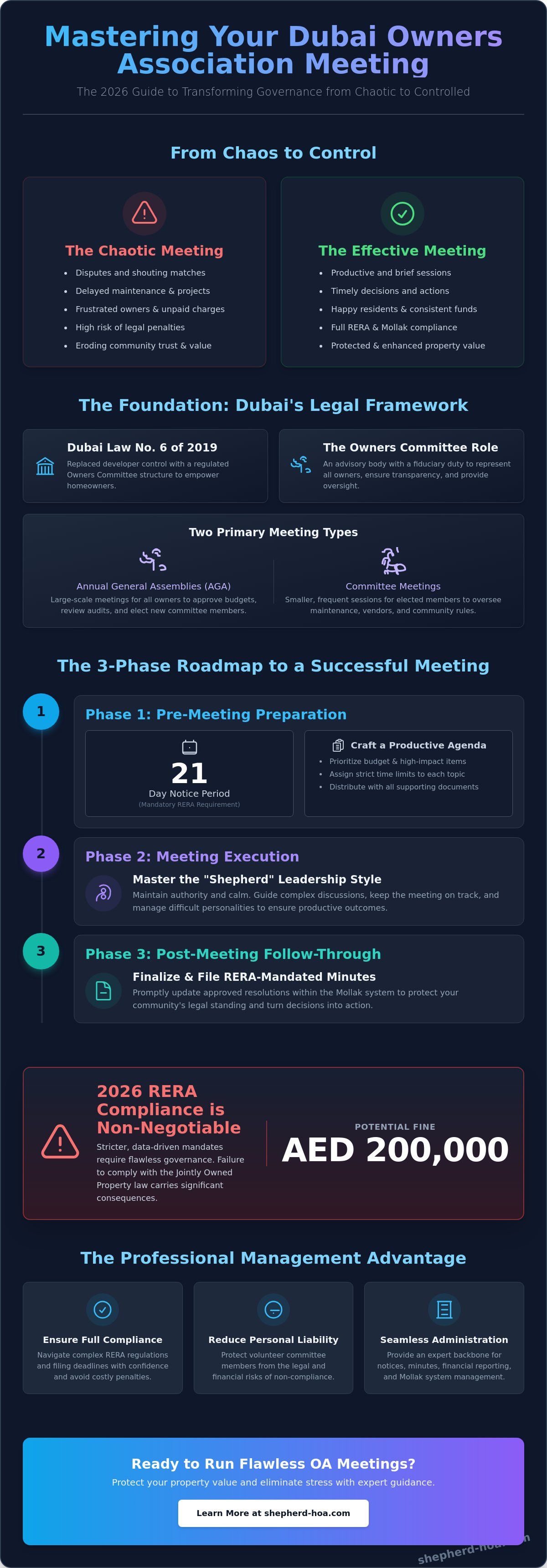
Effective governance in Dubai begins with a clear grasp of the legal landscape. Dubai Law No. 6 of 2019 redefined how communities operate, shifting the power dynamic from developer-controlled models to a regulated Owners Committee structure. Your primary objective as a committee member is to protect property values and resident quality of life. Understanding how to run an effective owners association meeting starts with recognizing that these sessions are the legal heartbeat of your building.
Gaining a foundational understanding HOA governance is vital for every board member. While international models vary, Dubai's system is distinct. You aren't just a volunteer; you're a guardian of a collective asset. Meetings aren't social gatherings. They're formal requirements that ensure transparency and accountability across the community.
You'll navigate two primary meeting types in your role:
Annual General Assemblies (AGA): These are large-scale meetings where all unit owners gather to approve annual budgets, review financial audits, and elect new committee members.
Committee Meetings: These are smaller, more frequent sessions where the elected members meet with the management company to oversee maintenance, service provider performance, and community rules.
The Role of the Owners Committee
The Owners Committee serves as an advisory body rather than an executive one. You don't handle the daily cleaning schedules or security rosters; the licensed management company manages those tasks. Your role is to provide oversight and represent the owners' interests. You owe a fiduciary duty to the entire community. This means every decision must prioritize the long-term health of the building over personal preferences. Transparency is your most effective tool. Sharing meeting minutes and financial updates quickly builds a culture of trust and reduces resident friction.
Strata Law Compliance in 2026
In 2026, RERA mandates for community governance are stricter and more data-driven. Compliance isn't a suggestion. Professional Owners Association Management in Dubai ensures your building meets every legal benchmark, from filing quarterly reports to maintaining the Mollak system. If you fail to hold a required AGA or neglect statutory filings, the penalties are significant. Financial fines for violating the Jointly Owned Property law can reach up to AED 200,000. Learning how to run an effective owners association meeting is the best way to avoid these liabilities while ensuring your community remains a premium place to live.
Pre-Meeting Preparation: Setting the Stage for Success
Success in the boardroom starts weeks before the first attendee arrives. If you want to master how to run an effective owners association meeting, you must treat the preparation phase as your foundation for legal compliance and community trust. In Dubai, the Real Estate Regulatory Agency (RERA) requires specific protocols that protect both the board and the homeowners. Missing a single step can lead to contested votes or administrative delays.
Your first priority is the 21-day notice period. This isn't just a suggestion; it's a regulatory requirement. Serve official notice to all owners through approved channels, ensuring every member has the opportunity to review the materials. This lead time allows residents to prepare their questions, which leads to more constructive dialogue during the actual session. It also ensures that the board remains compliant with Law No. (6) of 2019 regarding jointly owned property in Dubai.
Crafting a Productive Agenda
A vague agenda is a recipe for a four-hour meeting that achieves nothing. Structure your document by prioritizing high-impact items that directly affect property values, specifically community service charge budgets. By addressing financial obligations early, you ensure the most critical decisions receive the most energy when participants are most focused.
Assign strict time limits, such as 10 or 15 minutes, to each discussion point to prevent meeting creep.
Distribute the agenda alongside the previous meeting's minutes to provide immediate context for recurring issues.
Reserve a brief "Any Other Business" (AOB) section at the end for minor concerns, ensuring they don't derail the primary objectives of the meeting.
Financial Transparency and Mollak
Transparency is the most effective tool for reducing friction within a community. Use data directly from the Mollak system to provide an accurate, real-time snapshot of the association's health. Board members should prepare clear visual aids that show current collection rates and how they compare to the previous quarter. If the collection rate is sitting at 85%, explain the specific steps being taken to recover the remaining 15%.
Clearly report the status of the reserve fund. Owners need to see that their AED is being protected for future capital expenditures, like elevator overhauls or facade maintenance. When you present these figures with clarity, you transform the board from a group of enforcers into trusted guardians of the community's assets. Utilizing automated management platforms can help you generate these reports with a single click, saving hours of manual data entry and reducing the risk of human error.
Finally, confirm your logistics. If you're hosting a virtual or hybrid meeting, test the platform's voting features 48 hours in advance. If meeting in person, ensure the venue has sufficient seating and functional audio-visual equipment. Technical delays during the meeting erode your authority and waste the time of every volunteer in the room.
Execution: How to Lead the Meeting with Authority and Calm
Adopting a shepherd approach transforms the dynamic of your board meeting. You aren't there to dictate terms; you're there to protect the process and guide the community toward productive outcomes. Mastering how to run an effective owners association meeting requires you to act as a steady facilitator who maintains order while ensuring every voice feels heard. This balance prevents the session from devolving into a grievance airtime and keeps the focus on the 2026 budget or pending maintenance contracts.
Establish clear ground rules at the very start of the session. Limit individual speaking time to three minutes per agenda item to ensure the meeting concludes within the scheduled 90 minutes. Many successful boards in Dubai utilize a simplified version of Robert’s Rules of Order to manage motions and voting. This structure provides a predictable framework that minimizes interruptions. By sticking to a formal procedure, you remove the personal element from disagreements, making it easier to stay objective and professional.
Conflict Resolution and Difficult Personalities
Tensions often rise when discussing service charges or community upgrades. When an owner becomes confrontational, acknowledge their concern without letting it derail the scheduled topics. Use neutral language like, "I understand this is a priority for you; let's record this for the management report." This validates the resident while keeping the agenda moving. Your professional management company serves as a vital buffer here. They can provide technical data or regulatory context, allowing the board to remain a calm, decision-making body rather than the target of emotional outbursts.
Navigating the Quorum Challenge
Achieving a quorum is a frequent hurdle for UAE owners associations. Under RERA guidelines and Law No. (6) of 2019, specific attendance thresholds must be met for a meeting to be legally valid. If you fail to meet the 25 percent or 50 percent requirement specified in your community's constitution, you must follow the formal adjournment process. This usually involves rescheduling the meeting for a later date where the quorum requirement may be lower or the attendees present constitute a quorum.
To avoid the cost and delay of adjourned meetings, leverage digital tools for proxy collection. Modern platforms allow owners to submit their votes or appoint a proxy through secure, RERA-compliant systems like Mollak. Sending automated reminders three days and 24 hours before the meeting can increase attendance by up to 40 percent. Offering a hybrid attendance model ensures that even owners traveling abroad can participate, securing the numbers you need to finalize essential community decisions.
Post-Meeting Follow-Through: Turning Decisions into Action
The true measure of how to run an effective owners association meeting lies in what happens after the room clears. Decisions made during the session only hold value if they're executed with precision and recorded according to RERA standards. A board's credibility depends on its ability to transition from discussion to delivery within the first 72 hours post-adjournment. This phase acts as the protective backbone of your community governance, ensuring that every vote translates into a tangible improvement for the property.
The Art of Writing Effective Minutes
Minutes serve as the official historical and legal record of the community. Don't fall into the trap of creating verbatim transcripts that record every minor disagreement. Instead, focus on action-oriented minutes. These documents should clearly state the motion proposed, the name of the member who moved it, the seconder, and the final vote count, including any abstentions. The secretary must finalize these records quickly; under Law No. (6) of 2019, maintaining accurate records isn't just a best practice, it's a fiduciary requirement. Well-structured minutes provide the board with legal protection and ensure that future boards understand the rationale behind current expenditures.
Integrating with Mollak and RERA
In Dubai's regulated landscape, a meeting's resolutions aren't fully realized until they're reflected in the Mollak system. Once the board approves the annual budget, the management team must upload these figures to ensure service charge invoices are generated in AED without delay. If the meeting resulted in a decision for major capital expenditure, such as a chiller replacement or facade maintenance, you'll need to secure specific RERA approvals before moving forward. For a technical breakdown of these requirements, refer to this Mollak Dubai guide to ensure your community remains compliant and avoids administrative fines.
Transparency is the final step in the follow-through process. While the full minutes are vital for the record, a brief "Meeting Highlights" email sent to all homeowners within 48 hours builds immense trust. This summary should include:
Approved Projects: Specific timelines for upcoming maintenance or facility upgrades.
Financial Updates: Status of the reserve fund or changes to service charge collection strategies.
Action Assignments: Which committee or manager is responsible for specific tasks.
Next Steps: The date for the next follow-up or town hall.
By closing the loop quickly, you demonstrate that the board is a proactive guardian of the owners' assets. This structured approach is the hallmark of how to run an effective owners association meeting that actually produces results. When owners see their concerns addressed and decisions implemented, the stress of community management dissolves into a sense of organized control.
Ready to streamline your board's administrative workload and ensure total compliance? Discover how Shepherd HOA simplifies community management for boards across the UAE.
Why Professional Management is the Key to Effective Meetings
A well-organized board is only as strong as its administrative foundation. Professional managers act as an invisible backbone for the committee, handling the complex logistics that often derail volunteer-led sessions. When you master how to run an effective owners association meeting, you realize that success depends heavily on pre-meeting preparation and post-meeting execution. Managers ensure that every agenda item aligns with the Master Community Declaration and that minutes are recorded with legal precision. This oversight removes the administrative burden from board members, allowing them to focus on strategic decisions rather than paperwork.
Compliance isn't just about following rules; it's about protection. In the UAE's evolving regulatory landscape, expertise in RERA compliance reduces the personal liability of volunteer members. Professional managers navigate the nuances of Law No. (6) of 2019, ensuring that every resolution passed during your meeting stands up to legal scrutiny. They also provide vital financial oversight. For example, when a community tenders a maintenance contract worth 250,000 AED, a third-party manager ensures a transparent bidding process. This prevents conflicts of interest and ensures that homeowners' funds are managed with the highest ethical standards.
Administrative Support: Managers handle notices, proxies, and quorum counts to ensure every meeting is legally valid.
Liability Mitigation: Expert guidance keeps board members protected by adhering to specific Dubai real estate regulations.
Financial Transparency: Independent oversight of service charge accounts and vendor payments builds trust within the community.
Conflict Resolution: Managers act as a neutral third party to de-escalate tensions during heated discussions, keeping the focus on the agenda.
The Shepherd HOA Difference
Shepherd HOA brings an authoritative yet accessible tone to community governance. We foster better relations by being a steady, expert guide for your board. Our proactive approach to RERA Dubai compliance ensures that your association remains ahead of any regulatory changes in 2026. We assign a dedicated manager who treats your community as a unique entity, not just a number on a spreadsheet. This personalized attention helps in preserving property values and maintaining the harmony that makes a neighborhood feel like home.
Taking the Next Step
Evaluating your current management is the first step toward better governance. If your meetings often exceed two hours without reaching clear resolutions, or if financial reports are consistently delayed, your current model may be failing you. Transitioning to a more effective system is a methodical process. We handle the heavy lifting of data migration and record auditing to ensure a seamless handover. It's time to replace the stress of community management with organized control. Contact our team today for a consultation on achieving community excellence and discovering how to run an effective owners association meeting with professional support.
Elevate Your Community Governance for 2026
Running a successful board isn't just about showing up; it's about meticulous preparation and strict adherence to RERA guidelines. You now have the clear framework for how to run an effective owners association meeting, from setting a compliant agenda to turning post-meeting minutes into actionable results. By aligning your strategy with Dubai’s specific regulatory requirements, you protect the board’s integrity and the community’s long-term financial health.
Since 2010, Shepherd HOA has focused on preserving property values across the UAE. Our team acts as a steady guide, navigating the complexities of the Mollak system so you don't have to manage the technical burden alone. As RERA-approved community management experts, we provide the professional oversight needed to ensure every meeting is productive and every decision is compliant.
You have the tools to lead with authority. Let’s work together to build a more harmonious and well-managed community for every resident.
Frequently Asked Questions
What is the minimum notice period for an Owners Association meeting in Dubai?
The minimum notice period for an Annual General Assembly is 21 days. This requirement, set by Law No. 6 of 2019, ensures every homeowner has enough time to review the agenda and financial reports. For smaller committee meetings, the notice period is usually 7 days. Providing this notice is a foundational step in how to run an effective owners association meeting because it ensures transparency and legal compliance.
Can an Owners Committee make financial decisions without a general assembly?
No, the Owners Committee doesn't have the authority to approve the annual budget or service charges on its own. These major financial milestones require a formal vote from the General Assembly through the RERA Mollak system. The committee acts as an oversight body that reviews the management company's performance and ensures the community's AED 1 million or larger budget is spent according to the approved plan.
How is a quorum calculated for a Dubai community meeting?
A quorum is achieved when owners representing at least 50% of the total units are present in person or by proxy. This calculation is based on the number of units rather than the physical number of people in the room. If your community consists of 200 units, you must have representation for 100 units to proceed with the first scheduled meeting under RERA guidelines.
What happens if we cannot reach a quorum for the Annual General Assembly?
The meeting must be adjourned and rescheduled for a date between 7 and 14 days later if the 50% threshold isn't met. At the second meeting, the quorum requirement typically drops to 25% of owners, or in some cases, the meeting is valid regardless of the number of attendees. This rule prevents a small group of absent owners from stalling essential community maintenance and administrative tasks.
Are virtual Owners Association meetings legally recognized by RERA?
Yes, RERA fully recognizes virtual and hybrid meetings as long as they're conducted through authorized platforms like the Mollak system. Digital meetings are a modern standard for how to run an effective owners association meeting in 2026. They allow international investors to participate in community governance without needing to be physically present in Dubai, which often leads to higher engagement rates.
Who is responsible for taking the minutes at an OA meeting?
The licensed management company is legally responsible for recording and distributing the minutes of the meeting. They must capture all resolutions and voting results accurately to maintain the community's legal standing. Once the meeting concludes, the manager has 10 days to upload these minutes to the Mollak portal so all owners can review the official record of the proceedings.
How often must a Dubai Owners Committee meet by law?
The Owners Committee is required to meet at least once every quarter, totaling four times per year. These regular check-ins ensure that the board maintains its fiduciary duty and keeps a close watch on the management company's activities. Consistent meetings help prevent administrative backlogs and ensure that any maintenance issues are addressed before they require costly emergency repairs paid in AED.
Can a tenant attend or vote in an Owners Association meeting?
Tenants don't have the legal right to vote or participate in the decision-making process of an Owners Association. Only the registered property owner, or a person holding a notarized power of attorney, can cast a vote on community matters. While a board might allow a tenant to attend as an observer to discuss specific building issues, they remain excluded from all formal resolutions and elections.


Comments