
Understanding Oqood vs Title Deed in Dubai: The 2026 Property Owner’s Guide
- Sohrab Virani

- Apr 27
- 12 min read
Last month, an investor in Dubai Creek Harbour realized their luxury unit was 100% complete, yet they still lacked the final document required to secure their asset. This confusion often stems from the critical gap between initial registration and final ownership. Gaining a clear understanding oqood vs title deed is the only way to protect your capital and ensure you're meeting Dubai Land Department requirements. You shouldn't have to guess whether your property is legally secure or when your service charge obligations actually begin.
We understand that managing a property portfolio involves enough complexity without the added weight of legal jargon. That's why we've designed this 2026 guide to act as your expert guardian through the handover process. You'll learn exactly how to transition from an off-plan Oqood to a permanent Title Deed, including the specific steps to facilitate issuance and the standard 4% DLD registration fees. This article provides a logical roadmap to move from uncertainty to total ownership confidence.
We'll examine the regulatory timeline, service charge transitions, and the protective measures every 2026 investor needs to know to maintain community harmony and asset value.
Key Takeaways
Identify the critical legal differences between Oqood for off-plan units and Title Deeds for completed properties to protect your ownership rights.
Simplify your investment journey by understanding oqood vs title deed and the specific registration fees required at each stage of the property lifecycle.
Master the transition process from handover to final deed issuance, including the vital role of completion certificates and DLD-verified surveys.
Learn how the issuance of a Title Deed triggers your service charge obligations within the Mollak system to ensure seamless financial compliance.
Discover how professional RERA and DLD guidance can safeguard your community’s governance and maintain the long-term value of your UAE assets.
Table of Contents Defining Oqood and Title Deed: The Pillars of Property Ownership Oqood vs Title Deed: A Direct Comparison for Homeowners The Handover Bridge: How Your Oqood Transitions to a Title Deed Why the Distinction Matters for Service Charges and Governance Securing Your Investment: Professional Guidance for Owners
Defining Oqood and Title Deed: The Pillars of Property Ownership
Securing property ownership in Dubai relies on two distinct documents managed by the Dubai Land Department (DLD). These certificates serve as the legal backbone for every real estate transaction in the emirate. Without them, an investor lacks government-backed protection and formal recognition of their assets. The DLD acts as the sole regulatory body responsible for issuing these documents, ensuring that every transaction complies with Law No. 7 of 2006 concerning land registration. Understanding oqood vs title deed is the first step for any 2026 property owner to ensure their investment remains safe and compliant. This system of land registration ensures that every square meter of Dubai's real estate is accounted for in a centralized, transparent database.
The DLD utilizes these two registers to maintain community harmony and protect the financial interests of all parties. These documents are the only legally recognized proofs of ownership in the national real estate market. They provide a clear audit trail from the moment a project is launched until the keys are handed over to the final owner. By centralizing this data, the Dubai government eliminates the risks of fraudulent sales or overlapping claims, giving board members and individual owners peace of mind.
What is an Oqood Certificate?
The term "Oqood" translates from Arabic as "contracts." It serves as an administrative tool used specifically for off-plan properties that are still under construction or in the development phase. When you buy a property before it's finished, the DLD records the sale in the Initial Register. This registration protects you against developer misconduct or unauthorized resale of the unit to another party. It ensures the developer can't change the terms of the unit's allocation without formal oversight. Oqood is the mandatory pre-title registration for all off-plan transactions.
What is a Property Title Deed?
Once a project receives its Building Completion Certificate (BCC) and the unit is ready for occupancy, the property moves from the Initial Register to the permanent Real Estate Register. This transition marks the end of the off-plan stage and the beginning of full ownership. The Title Deed is the final, permanent proof of ownership for completed units. It contains specific data that defines your asset, including:
The unique plot number assigned by the DLD.
The exact unit dimensions and floor area.
The owner’s specific shares in the common areas of the building.
The date of registration and the owner's legal identification details.
The Title Deed is essential for daily property management and financial planning. You can't secure a mortgage from a UAE bank or set up essential utility accounts with DEWA without this document. It acts as the definitive solution for establishing your rights as a homeowner, allowing you to manage your property with organized control and authority.
Oqood vs Title Deed: A Direct Comparison for Homeowners
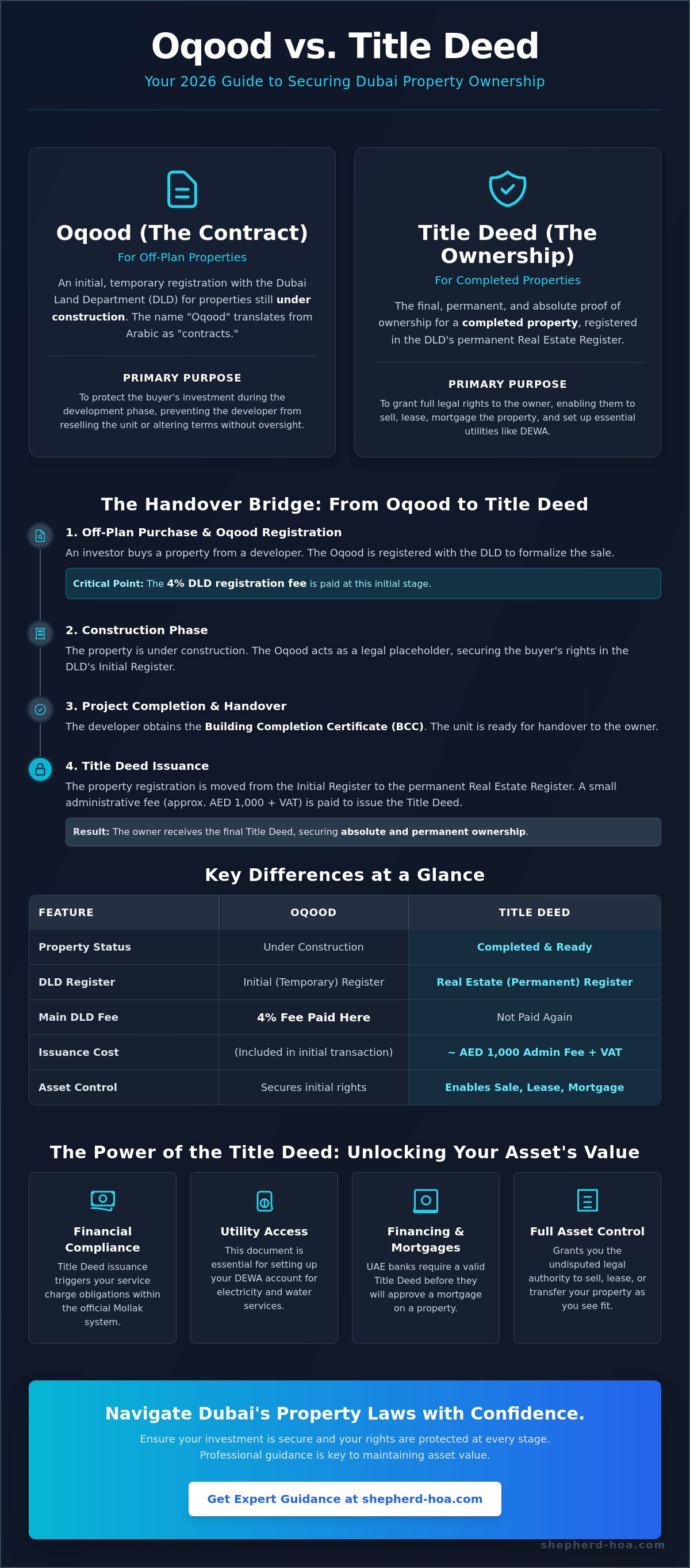
The primary distinction between Oqood and a Title Deed lies in the construction status of your investment. Oqood serves as a safeguard for off-plan properties. It acts as a temporary registration in the Dubai Land Department (DLD) initial registry. Once the developer completes the project and the building receives its certificate of completion, this document transitions into a Title Deed. This final document represents permanent, absolute ownership of a ready property. Understanding oqood vs title deed is vital for managing your financial obligations and legal rights. While both documents confirm your interest in a property, the Title Deed is the only instrument that grants full rights for occupancy and long-term leasing. Think of the Oqood as a protective contract that ensures your rights are recorded while the building is still under construction.
Key Differences at a Glance
Registration Process: Oqood is a pre-registration (Initial Property Register) conducted by the developer. The Title Deed is the final registration in the Land Register.
The 4% DLD Fee: You pay the 4% DLD registration fee at the Oqood stage. You do not pay this fee again when the property is finished. You only pay a standard administrative fee, often around AED 1,000 plus VAT, to issue the final Title Deed.
Validity Period: Oqood is a transitional document. It expires the moment the property is handed over and the final Title Deed is generated. The Title Deed is permanent and has no expiration date.
Reselling and Renting: Document Requirements
Property owners often ask if they can trade assets before completion. Under DLD regulations for 2026, you can sell a property with an Oqood, provided you meet the developer's specific payment threshold. Most Dubai developers require the owner to have paid at least 40% of the total purchase price before issuing a No Objection Certificate (NOC) for resale. This ensures market stability and protects the community's financial health. Leasing requires a different level of documentation. You cannot register an Ejari contract or legally rent out a unit using only an Oqood. A Title Deed is mandatory for all rental transactions. This document provides the legal certainty tenants and authorities require. It also impacts property valuation; ready properties with Title Deeds typically command higher buyer confidence because the asset is tangible and immediate. Maintaining organized records of these documents is a core part of community stability. Shepherd HOA acts as a steady guide for boards, helping ensure that
The Handover Bridge: How Your Oqood Transitions to a Title Deed
The movement from an off-plan contract to permanent legal ownership is a structured journey. This transition begins officially when the developer secures the Building Completion Certificate (BCC) from relevant authorities like Dubai Municipality or Trakhees. This certificate confirms the project is finished and safe for occupancy. Once the BCC is in hand, the developer conducts a final survey to verify the exact square footage of each unit. This step is essential for understanding oqood vs title deed because the final deed must reflect the physical reality of the built space, not just the initial architectural drawings.
Before the DLD issues the Title Deed, you must settle all final accounts. This includes paying the remaining balance of the purchase price and any applicable administrative fees. You'll also perform a snagging inspection to identify any construction defects that require rectification. The developer acts as the primary facilitator during this phase, managing the communication with the Dubai Land Department to ensure the registration process moves forward efficiently. Their role involves submitting the final survey data and proof of your payment to trigger the cancellation of the Oqood in favor of the permanent deed.
Steps to Convert Oqood to Title Deed
Obtain the official Handover Notice and clear all outstanding developer payments, including service charge provisions.
Provide the original Oqood certificate to the developer or DLD for cancellation.
Verify that the developer has registered the final unit area with the DLD following the completion of the building.
The property handover dubai is the critical window where legal status changes. It's the moment your investment shifts from a contractual promise into a tangible, registered asset.
Common Delays in the Transition Process
Area variations represent the most frequent cause of delay. Most Sales and Purchase Agreements (SPA) include a clause allowing for a 5% variance in size. If the final survey shows a discrepancy larger than this margin, it can lead to financial disputes that stall the Title Deed issuance. Additionally, developer delays in securing the BCC can push back handover dates by several months. Professional oversight during this transition ensures these hurdles don't stall your ownership rights. A clear grasp of understanding oqood vs title deed allows you to monitor these milestones effectively, ensuring your transition to a full owner is as seamless as possible.
Why the Distinction Matters for Service Charges and Governance
The transition from Oqood to a Title Deed represents a significant shift in your financial and administrative role within a community. While Oqood serves as a protective registration during construction, the Title Deed is the document that fully integrates you into the Dubai Land Department’s regulatory ecosystem. This change affects how you pay for the upkeep of your building and how much influence you have over community decisions. Understanding oqood vs title deed is essential for any owner who wants to protect their investment from administrative mismanagement.
Service Charges and the Mollak System
In Dubai, the collection of service charges is strictly regulated to prevent the misuse of funds. The mollak dubai system serves as the central hub for these transactions, but it operates based on Title Deed data. You'll find that you cannot pay service charges through Mollak until your Title Deed is processed and updated in the system. This is because the system requires a finalized unit registration to generate a RERA-approved invoice.
Once the Title Deed is issued, the financial responsibility for the unit officially moves from the developer to the homeowner. This step ensures total transparency in how your AED contributions are spent. Because Mollak requires a Title Deed, it prevents developers from charging arbitrary fees that haven't been audited and approved by RERA. It’s a mechanism that provides peace of mind, ensuring every dirham you pay goes toward the actual maintenance and insurance of your property.
Community Governance and Owners Committees
Governance rights are perhaps the most overlooked aspect of understanding oqood vs title deed. Under Law No. (6) of 2019, your ability to participate in the direction of your community depends on your registration status. Only owners with a valid Title Deed are eligible for election to the Owners Committee. While Oqood holders are recognized as the rightful future owners, they don't yet possess the full legal standing required to vote on community budgets or service provider appointments.
Voting Rights: Title Deed holders have the authority to approve or contest community expenditures during annual meetings.
Committee Eligibility: You must have a registered deed to serve as a member of the committee that oversees the management company.
Developer Obligations: Developers are legally required to register the community with RERA and facilitate the handover of management responsibilities to ensure compliance.
Professional owners association management dubai plays a vital role during this phase. These managers act as a steady guide, helping newly registered Title Deed holders navigate their roles in the committee. They ensure that the interests of all stakeholders are protected and that the community remains a harmonious place to live. By securing your Title Deed, you aren't just getting a certificate; you're gaining the legal power to safeguard your property's long-term value.
Ensure your community is managed with professional precision; see how Shepherd HOA can streamline your board's administrative duties and maintain compliance.
Securing Your Investment: Professional Guidance for Owners
Transitioning from an off-plan contract to full ownership requires more than just a signature. While understanding oqood vs title deed is the first step, the final conversion involves rigorous interaction with the Dubai Land Department (DLD). Expert partners ensure your property adheres to all current regulations, preventing administrative delays that can stall your move-in date or resale plans. As the 2026 market continues to evolve, having a steady guide helps you manage the transition with absolute certainty.
The Role of Professional Management
Professional management acts as a shield during the critical handover phase. Shepherd HOA monitors developer compliance to ensure every legal requirement is met before you take the keys. We conduct detailed audits of service charge calculations during that first year of completion. This prevents homeowners from overpaying and ensures transparency in how every AED is spent. By securing official rera dubai approvals, we establish a stable foundation for your community governance. We act as the seamless interface between you, the developer, and government agencies, managing the technical details so you don't have to.
Next Steps for New Homeowners
Your journey toward full ownership becomes simpler with the right tools. Use the Dubai REST app to verify your Oqood status immediately. This digital verification is your primary defense against registration errors. Once your Title Deed is issued, the focus shifts to community health. Shepherd HOA provides the "Shepherd" oversight needed to maintain your property's value through administrative excellence. We handle the fiduciary duties and compliance tasks that often overwhelm volunteer boards, replacing stress with organized control.
Final Checklist for Property Completion:
Confirm your Oqood is registered in the DLD system via the Dubai REST app.
Verify that all installment payments match the developer's records exactly.
Review the initial service charge budget for RERA compliance before making payments.
Gather all completion certificates and structural warranties from the developer.
Contact Shepherd HOA to discuss your community's administrative roadmap and governance.
Mastery of understanding oqood vs title deed ensures you aren't caught off guard by the 4% DLD fee or registration timelines. Our team stands ready to guide you through the complexities of Dubai real estate law, protecting your investment from the moment of handover and beyond. We provide the invisible backbone that keeps your community thriving and your property values protected.
Protecting Your Asset Through the Handover Process
Navigating the shift from off-plan registration to full ownership requires precision. understanding oqood vs title deed is the first step in ensuring your 2026 property goals remain on track. Since 2010, Shepherd HOA has acted as a steady guide for owners through these technical transitions with deep RERA and DLD expertise. We specialize in the formal transition of property units from developer to owner, ensuring every record is accurate within the Mollak system. This level of oversight protects your financial interests and maintains community harmony through transparent financial reporting. Whether you're managing a single unit or serving on a board, professional management prevents the administrative friction that often follows a property handover. Our team delivers rigorous compliance to safeguard your investment's long-term value. Ensure your community management is RERA-compliant with Shepherd HOA. You've worked hard to secure your place in Dubai's skyline; let us provide the organized control and peace of mind your community deserves.
Frequently Asked Questions
What happens to my Oqood once the property is completed?
Your Oqood certificate automatically converts into a Title Deed once the Dubai Land Department (DLD) registers the building as completed. This transition marks the official change from an off-plan contract to a finished physical asset. The developer coordinates with the DLD to issue the final deed, ensuring your ownership is recorded in the permanent real estate register.
Can I sell my property if I only have an Oqood certificate?
Yes, you can sell your property before completion using the Oqood certificate through a process called an off-plan resale. You'll need to obtain a No Objection Certificate (NOC) from the developer to proceed. Most developers require you to have paid a minimum of 30% to 40% of the total property value before they'll approve the resale to a new buyer.
Do I have to pay for the Title Deed if I already paid for Oqood?
You don't have to pay the 4% DLD registration fee again if you paid it during the Oqood registration process. Understanding oqood vs title deed costs is simple because the initial 4% fee covers the final deed issuance. You'll only need to pay minor administrative costs, such as the AED 250 fee for the deed certificate and the AED 290 fee for the land map.
Is an Oqood certificate a legally binding proof of ownership?
An Oqood certificate is a legally binding document that registers your ownership rights in the interim real estate register. It protects your interests under Law No. 13 of 2008, which mandates that all off-plan sales in Dubai must be registered. While it isn't a final Title Deed, it's the official DLD proof that you're the rightful owner of the unit under construction.
How long does it take to get a Title Deed after handover?
The process typically takes between 30 and 60 days after the developer receives the Building Completion Certificate (BCC). This timeline allows the developer to finalize the building's division and submit the necessary documentation to the DLD. Once the DLD processes these files, they'll issue individual Title Deeds to replace the interim Oqood registrations for all owners.
Can I register for utilities like DEWA with an Oqood certificate?
No, you can't register for DEWA or other utility services using only an Oqood certificate. These providers require a final Title Deed or a signed handover certificate as proof that the property is habitable. Because Oqood is specifically for properties under construction, utility companies won't activate accounts until the unit is officially finished and possession is transferred to you.
What is the DLD registration fee for a Title Deed in 2026?
The DLD registration fee remains 4% of the property's total purchase price as of 2026. This fee is a mandatory requirement for all real estate transactions in Dubai to ensure legal protection. For a property priced at AED 1,500,000, the fee amounts to AED 60,000. You'll also pay a Knowledge Fee of AED 10 and an Innovation Fee of AED 10 per transaction.
Who is responsible for applying for the Title Deed, the owner or the developer?
The developer is responsible for initiating the Title Deed application process by registering the completed project with the DLD. They must submit the final floor plans and unit details to ensure each owner receives an accurate deed. While the developer handles the administrative filing, you'll need to provide updated documents like your Emirates ID and passport copy to complete the registration.


Comments