
Developer Handover Process Explained: The 2026 Homeowner’s Guide to Property Transition
- Sohrab Virani

- Apr 25
- 12 min read
Receiving your "Notice of Completion" isn't just a milestone; it's the most critical 30-day window for protecting your multi-million AED investment from hidden structural liabilities. You've likely spent years anticipating this moment, yet the sudden influx of RERA requirements and Mollak registrations can quickly turn excitement into a logistical headache. This guide provides the developer handover process explained through the lens of 2026 UAE regulations, ensuring you secure every legal right and catch every construction defect before you sign the final papers.
We're here to act as your expert guide through this transition. You'll learn how to master every stage of the property transition, from initial notice to key collection, while maintaining full compliance with national real estate laws. We'll walk you through the four essential stages of the handover, including utility setups and the rigorous inspections needed to protect your property's long-term value. Our goal is to replace the stress of community management with a sense of organized control and peace of mind.
Key Takeaways
Navigate the five essential stages of the developer handover process explained in this guide to secure your investment and ensure full compliance with UAE regulations.
Master the snagging inspection to identify critical defects before settlement, effectively utilizing your 12-month Defect Liability Period (DLP) as a vital safety net.
Understand how a seamless transition from developer control to independent Owners Association management safeguards the long-term value of shared community amenities.
Discover why professional oversight during the transition prevents costly legal disputes and ensures a stress-free experience for board members and homeowners alike.
Table of Contents Understanding the Developer Handover Process: A Strategic Overview The 5 Essential Stages of a Successful Handover Navigating Snagging, Defect Liability, and Legal Compliance From Developer Control to Owners Association Management Securing Your Investment with Professional Oversight
Understanding the Developer Handover Process: A Strategic Overview
The developer handover process is the formal legal and physical transfer of a completed property from the developer to the purchaser. In the UAE's 2026 real estate market, this transition represents the moment your financial commitment transforms into a tangible asset. It isn't just a meeting to collect keys; it's a critical phase where legal liability and maintenance costs shift to your shoulders. Understanding the developer handover process explained in this guide ensures you protect your equity from day one.
The first 90 days following completion are the most vital for your investment's return on investment (ROI). During this window, you must identify latent defects that could otherwise cost thousands of AED in future repairs. A property that begins its life with a clean bill of health attracts higher rental yields and sustains its value better than one with unresolved snagging issues. This period serves as your primary opportunity to hold the developer accountable before the standard one-year defect liability period begins to lapse.
It's essential to distinguish between the 'Unit Handover' and the 'Community Handover.' Your unit handover focuses on your specific apartment or villa. The community handover involves the transfer of shared assets like gyms, pools, and lobbies to the Owners Association or a management firm. The construction handover process ensures that both your private space and these shared facilities meet the promised specifications and safety standards defined in your Sales and Purchase Agreement (SPA).
The Legal Framework of Property Transitions
UAE strata laws, specifically Law No. 6 of 2019 regarding jointly owned properties in Dubai, provide the legal shield for owners. These regulations mandate that developers remain responsible for structural defects for 10 years. The Dubai Land Department (DLD) plays a central role by verifying that the project is 100% complete before issuing the final Title Deed. When you receive the 'Notice of Completion,' it acts as the official signal that your legal responsibilities, including service charge payments and utility registrations, are about to commence.
Key Stakeholders in Your Handover Journey
Success during this transition depends on three primary parties meeting their obligations promptly:
The Developer: They must provide a completion certificate, operation and maintenance (O&M) manuals, and a snag-free property before they're entitled to the final 5% or 10% payment.
The Owner: You're responsible for conducting a thorough inspection within the 14-day window typically specified in the notice. You must also submit all required documentation and settle any outstanding balances to avoid delays.
The Management Company: We act as the invisible backbone of the community. Our role is to ensure the transition of common areas is seamless, maintaining harmony and protecting the long-term viability of the neighborhood's infrastructure.
By approaching the developer handover process explained here as a strategic business transaction, you secure your role as a proactive member of your new community. This organized control replaces the stress of the unknown with a clear path toward property ownership and financial stability.
The 5 Essential Stages of a Successful Handover
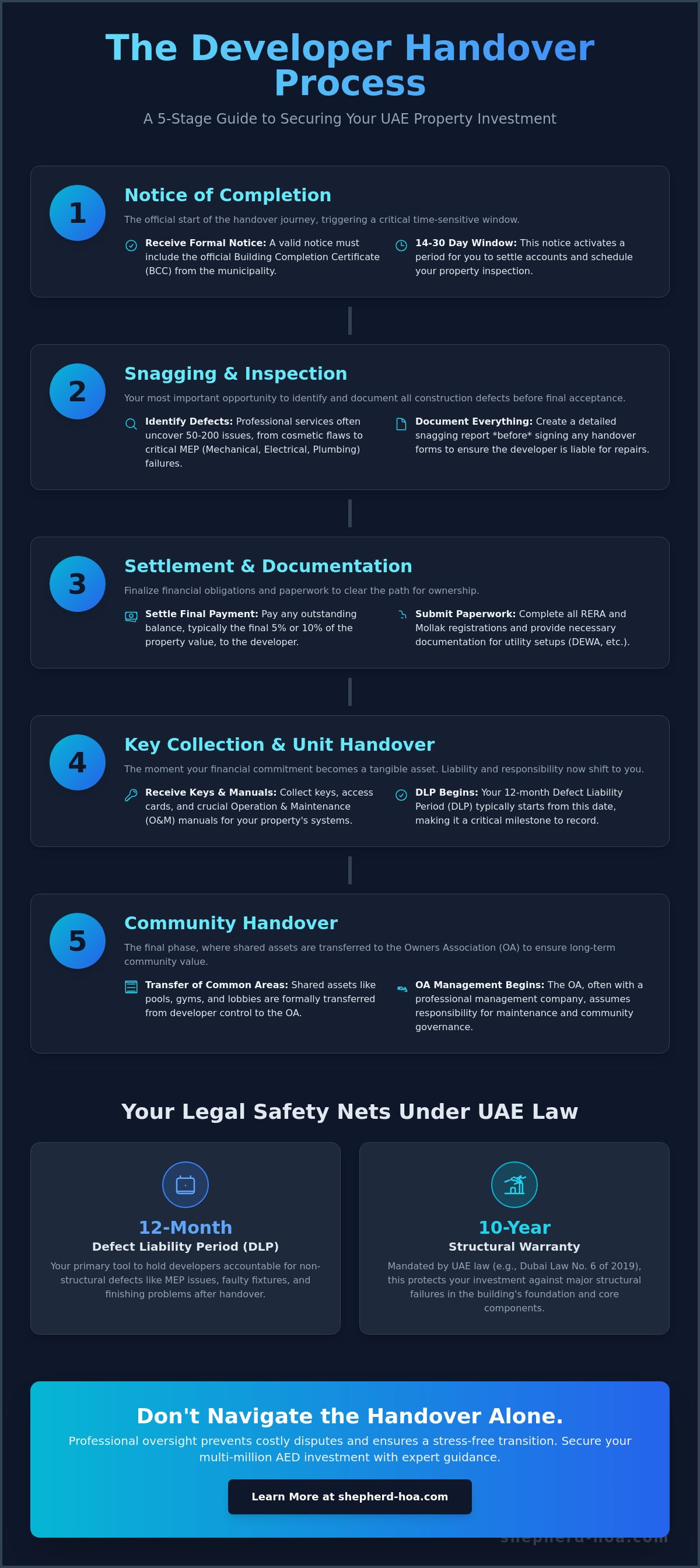
The developer handover process explained simply involves five distinct milestones that transition you from an investor to a resident. Each stage requires specific documentation and financial preparation to ensure your property rights are protected under UAE law. Following these steps methodically prevents common administrative headaches and secures your investment.
Stage 1 & 2: From Notice to Inspection
Your journey begins when you receive a formal Completion Notice. A valid notice must include a copy of the Building Completion Certificate (BCC) issued by the local municipality. You should verify that the developer has cleared all regulatory hurdles before you commit to the final payment. This notice typically triggers a 14 to 30 day window for you to settle your accounts and schedule your first site visit.
Snagging is the process of identifying construction defects for developer rectification. You shouldn't overlook this step. Professional snagging services in Dubai often identify between 50 and 200 individual issues, ranging from minor paint scuffs to critical MEP (mechanical, electrical, and plumbing) failures. By documenting these before signing the handover forms, you ensure the developer remains liable for repairs under their warranty obligations. This phase mirrors the technical standards found in a professional construction handover process, protecting your long-term asset value.
Stage 3 & 4: Clearing the Path to Ownership
Financial clearance involves more than just the final property installment. You'll need to prepare for the 4% Dubai Land Department (DLD) registration fee if you haven't paid it already. Additional costs often include administrative fees ranging from AED 500 to AED 5,000 and an advance service charge deposit, which typically covers the first quarter of community maintenance. Once these payments clear, the developer issues a No Objection Certificate (NOC) for the final title deed registration.
Efficient utility account setup is essential to avoid move-in delays. You'll need to register with DEWA (Dubai Electricity and Water Authority) and, in many communities, a district cooling provider like Empower or Tabreed. Expect to pay a security deposit of approximately AED 2,000 for apartments or AED 4,000 for villas. Completing these registrations early ensures that lights and air conditioning are active the moment you receive your keys.
Stage 5: Key Collection and the Homeowner’s Manual
The final step is the physical handover of keys, access cards, and parking remotes. You will receive a Homeowner’s Manual, which outlines the operation of appliances, emergency contacts, and community rules. This document acts as your guide for maintaining community harmony and property standards. It's a vital resource for understanding your role within the larger homeowners association. If you feel overwhelmed by these administrative requirements, using a dedicated management partner can provide the organized control you need to settle into your new home with peace of mind.
Navigating Snagging, Defect Liability, and Legal Compliance
The developer handover process explained often focuses on the excitement of receiving keys, yet the technical handover is where your financial interests are truly protected. Central to this transition is the Defect Liability Period (DLP), a 12-month safety net standard in UAE sales-purchase agreements. During this window, the developer is legally obligated to rectify non-structural defects at no cost to you. This is distinct from the 10-year decennial liability mandated by UAE Civil Code Article 880, which covers the building's structural integrity. You must act decisively during these first 365 days to ensure every deficiency is logged and repaired before the maintenance responsibility shifts to your personal budget.
The Professional Snagging Advantage
A simple walk-through isn't enough to secure a modern asset. Professional snagging services in 2026 utilize thermal imaging to identify heat leaks and MEP (Mechanical, Electrical, and Plumbing) testing to ensure your home's internal systems meet the latest efficiency standards. These experts find hidden snags like blocked floor drains, unbalanced electrical loads, or poorly insulated AC ducts that lead to moisture ingress. A detailed, independent report creates a clear paper trail. This empirical evidence forces developer accountability and ensures your property meets current safety and environmental regulations before you sign the final clearance certificate.
Compliance with Mollak and RERA
Your long-term satisfaction depends on clear financial structures and regulatory alignment. Understanding how Mollak Dubai ensures your service charges are transparent from day one is essential for every new homeowner in the Emirates. This system prevents developers from collecting unauthorized fees and ensures all payments are directed to RERA-approved escrow accounts. It acts as a guardian for your community funds, providing a level of oversight that was often missing in previous decades.
Before completing the handover, you should verify the developer’s compliance status through the Dubai REST app. Cross-referencing your proposed fees against the RERA Service Charge Index ensures your initial costs are within the 2026 market average. Taking these steps provides the peace of mind that your community’s infrastructure will be maintained without unexpected financial burdens or legal hurdles. This methodical approach to compliance is the backbone of a stable, harmonious neighborhood where property values are preserved through professional management and transparent governance.
From Developer Control to Owners Association Management
The developer handover process explained involves more than just receiving your front door keys. It marks the moment when the community handover begins. This is the official transfer of shared assets like gyms, rooftop pools, and lobbies from the developer's control to the collective ownership of the residents. Moving from developer-led management to an independent Owners Association (OA) is vital for long-term property value. While a developer focuses on completing the build, an OA focuses on the lifestyle and longevity of the building. This shift ensures that maintenance standards reflect the owners' interests rather than the developer's remaining construction budget.
The Owners Committee serves as the community's primary guardian. These elected members oversee the community's health and ensure that every dirham spent contributes to a better living environment. Professional Owners Association management replaces the typical stress of this transition with organized control. By implementing structured administrative systems, a professional manager protects the board from the administrative burden that often leads to volunteer burnout.
Establishing the Owners Association (OA)
In the UAE, specifically under Dubai’s Law No. 6 of 2019, the legal process of forming a board and appointing a licensed manager is a strict requirement. This board provides the necessary oversight of the community's financial and operational assets. One of the first tasks involves mastering the community service charge budget. The board must review initial projections for accuracy to ensure the AED per square foot rate covers actual utility costs and vendor contracts. Establishing a robust Reserve Fund is equally critical. This fund acts as a financial shield, protecting owners from sudden "special levies" when major repairs, such as chiller replacements or elevator overhauls, become necessary years down the line.
Ensuring Community Harmony from Day One
Setting clear community rules and regulations is the first step toward preserving a high-quality living environment. These rules define everything from parking etiquette to the use of shared amenities. Transparent communication between the board, the manager, and the residents prevents the friction that often plagues new developments during their first 12 months. Shepherd HOA acts as a steady guide during this complex first year of operation. We provide the technical expertise and administrative backbone required to handle compliance and vendor management. Our role is to ensure the developer handover process explained to residents is clear, fair, and efficient.
Secure your community's future and protect your investment with professional oversight. Partner with Shepherd HOA to streamline your transition today.
Securing Your Investment with Professional Oversight
Attempting a DIY handover often results in hidden financial liabilities that surface only after the developer's liability period expires. Without a technical eye, owners frequently miss structural defects or MEP (Mechanical, Electrical, and Plumbing) irregularities that can cost the association upwards of 85,000 AED in avoidable repairs. The developer handover process explained in this guide emphasizes that this transition isn't just a keys-for-cash exchange; it's a legal transfer of long-term responsibility. Shepherd HOA adopts a protective stance, acting as your expert guide to ensure the developer meets every contractual and regulatory obligation before they exit the site.
To protect your community's assets, you must secure a comprehensive document suite before the transition concludes. This documentation is vital for future maintenance and insurance claims. Ensure you receive the following items:
As-Built Drawings: Detailed architectural and engineering plans reflecting the final construction.
O&M Manuals: Operation and Maintenance manuals for all central systems like chillers, fire pumps, and elevators.
Warranties and Guarantees: Valid certificates for waterproofing, structural elements, and mechanical equipment.
BMS Access: Full administrative rights and passwords to the Building Management System.
Financial Records: Audited statements of service charge collections and utility deposits held by the developer.
The Value of Expert Representation
Professional handover services provide a clear return on investment by identifying defects that developers are legally bound to fix under Dubai Law No. 6 of 2019. This oversight removes the heavy administrative pressure from volunteer board members who don't always have the technical background to challenge developer claims. By ensuring RERA compliance from day one, we create a transparent framework that protects property values. Our team manages the technical snagging and legal paperwork, allowing you to focus on the human side of community building.
Next Steps for New Homeowners
Your journey as a homeowner begins with active participation. Request a professional handover audit for your community to identify outstanding issues before the developer's 12-month defect liability period ends. We recommend joining your local Owners Committee to help shape the governance and future of your neighborhood. If you're looking for a partner to provide an authoritative, stress-free transition, contact Shepherd HOA for a consultation. We'll act as the steady backbone of your community, ensuring the developer handover process explained here results in a secure, well-managed investment for the long term.
Take Command of Your Property Transition
Success in a new development depends on precise oversight during the critical first months. You've now seen the developer handover process explained, from the initial snagging inspections to the formal transfer of management responsibilities. Managing these stages correctly prevents long-term financial liabilities and ensures that the developer meets every contractual obligation before the defect liability period ends. It's about protecting the value of your AED investment through rigorous compliance and technical audits.
Shepherd HOA provides the professional backbone your board needs to navigate these complexities. With over 15 years of experience in UAE property governance, we offer RERA-approved expertise that prioritizes community harmony. Our team specializes in Mollak financial transparency, ensuring that every dirham is accounted for and every service contract is vetted for quality. We act as your expert guide, replacing administrative stress with organized control and clear communication.
Building a thriving community starts with a solid foundation. Let's work together to secure your property's future and provide the peace of mind your homeowners deserve.
Frequently Asked Questions
What is the standard timeline for a property handover in 2026?
The developer handover process explained for 2026 typically spans 30 to 60 days after the Building Completion Certificate (BCC) is issued. This window allows you to finalize your remaining payments, complete the Dubai Land Department (DLD) registration, and perform a detailed snagging inspection. Most developers provide a 14-day notice period for you to review the unit and sign the handover forms once the building's officially ready for occupancy.
Can I refuse to take handover if I find major snags during the inspection?
You can legally refuse to sign the handover certificate if the property has major snags that make it uninhabitable or unsafe. While minor cosmetic flaws like paint scuffs don't justify a refusal, structural issues or non-functional essential services like water and electricity are valid grounds for rejection. Documenting these defects in a formal report signed by both parties ensures you stay in control of the process while the developer completes the necessary repairs.
What are the mandatory fees I need to pay to the developer at handover?
Homeowners must pay a 4% DLD registration fee plus an administrative fee that usually ranges from AED 500 to AED 5,000. You're also required to pay the first installment of service charges in advance, which are calculated per square foot based on the RERA-approved budget. These payments are essential to secure your Title Deed and ensure the community's management services are funded from the moment you receive your keys.
How do I set up my DEWA and cooling accounts for a new property?
Activating your DEWA account requires your Title Deed or Oqood, a copy of your Emirates ID, and a security deposit of AED 2,000 for apartments or AED 4,000 for villas. For district cooling services through providers like Empower or Emicool, you'll need to register separately on their portal and pay a connection deposit. Most 2026 developments offer a digital move-in package to make this transition seamless and ensure your utilities are active before your move-in date.
What is the difference between the 1-year and 10-year warranty on new properties?
Developers in the UAE provide a one-year defect liability period for minor repairs and a 10-year warranty for structural integrity. The one-year period covers mechanical, electrical, and plumbing (MEP) systems, whereas the decennial liability ensures the developer remains responsible for the building's core stability. This dual-layered protection acts as a guardian for your investment, maintaining community harmony and long-term property values.
Who is responsible for managing the building once the developer hands over the keys?
A licensed Owners Association (OA) Management company takes over the daily operations of the building once the handover phase concludes. These professionals serve as a steady guide for the community, overseeing maintenance, security, and financial compliance under RERA regulations. Their primary duty is to provide the oversight needed to maintain common areas and protect the collective interests of all homeowners within the development.
How does the Mollak system affect my first service charge payment?
The Mollak system requires developers to register all service charge models with RERA for approval before they can issue any invoices. This ensures your first payment is deposited into a regulated escrow account rather than the developer's private account. Law No. 6 of 2019 mandates this process to provide transparency and ensure that every dirham you pay contributes directly to the professional upkeep of your community.
What happens if my developer delays the handover beyond the contract date?
If a developer delays the handover, most Sales and Purchase Agreements (SPA) include a 12-month grace period beyond the initial completion date. If the delay exceeds this 12-month window without a valid force majeure justification, you're entitled to seek compensation or contract termination through DLD channels. Reviewing your specific contract terms is a vital step in maintaining organized control over your investment during an unexpected delay.


Comments