

Mastering the Community Service Charge Budget in Dubai: A 2026 Board Member's Guide

A single clerical error in your Mollak submission can delay your community's funding for over 60 days, leaving essential maintenance contracts and security services in a state of limbo. You're likely tired of the constant friction between a 12% rise in regional utility expenses and the mandate for a transparent community service charge budget dubai. It's a heavy burden to balance the vocal demands of homeowners with the strict regulatory oversight of RERA. We understand that your role as a board member is a voluntary commitment that shouldn't feel like a full-time crisis management job.
This guide provides the definitive roadmap to secure a RERA-approved budget for 2026. You'll gain the technical insights needed to protect your community's AED 45 million asset value while completely eliminating the fear of compliance penalties or Mollak rejections. We will examine the specific steps to streamline your approval cycle, implement cost-saving measures that don't compromise service quality, and restore a sense of organized control to your board's financial planning sessions.
Key Takeaways
Understand the legal framework of Law No. 6 of 2019 to ensure your board remains fully compliant with RERA’s strict financial oversight.
Navigate the complete Mollak approval cycle with confidence, from internal draft preparation to the mandatory external audit required for official validation.
Learn how to balance immediate operational needs with long-term asset protection by properly structuring a community service charge budget dubai.
Implement strategic cost-saving measures, such as ethical tendering and energy-efficient upgrades, to reduce DEWA expenses and optimize your community's bottom line.
Discover how expert guidance can transform complex administrative burdens into a streamlined process that safeguards your property values and ensures long-term stability.
Table of Contents What is a Community Service Charge Budget in Dubai? The Mollak Approval Cycle: From Submission to RERA Approval General Fund vs. Reserve Fund: Balancing Today and Tomorrow Strategies for Optimising Operational Costs in 2026 Shepherd HOA: Your Expert Guide Through the Budgeting Maze
What is a Community Service Charge Budget in Dubai?
A community service charge budget in Dubai acts as the definitive financial blueprint for any jointly owned property. It outlines the projected costs for maintaining, repairing, and managing common areas and shared assets over a 12 month period. This document isn't just a suggestion; it's a calculated roadmap that determines the service fees every homeowner must pay to keep the community functional and attractive. When you manage a community service charge budget dubai, you're balancing the immediate needs of the building with the long-term preservation of the residents' investments.
The legal framework for these budgets rests on Law No. 6 of 2019. This legislation revolutionized property management in the Emirate by shifting oversight to the Real Estate Regulatory Agency (RERA). It mandates that all service charges be approved through the Mollak system, ensuring that developers and management companies can't set arbitrary fees. Under this law, the budget serves as a protective shield for owners, ensuring that every AED collected is earmarked for specific, verified community needs. Board members act as the primary guardians of this process. Understanding What is a Homeowner Association (HOA)? helps clarify that while Dubai uses different terminology like Owners Committees, the fiduciary duty remains the same. The board's most critical task is using the budget to protect property ROI, as a well-funded community maintains higher resale values and rental yields.
Looking toward the 2026 landscape, Dubai's approach to community management is becoming increasingly data-centric. We're seeing a move toward service charge indexing, where RERA uses historical data to benchmark costs across similar communities. This trend rewards efficient boards that optimize their spending while penalizing those with bloated operational costs. Staying ahead of these trends requires a proactive stance on budgeting that prioritizes smart technology and sustainable practices to keep fees competitive without sacrificing quality.
The Core Components of Your Budget
Operational expenses form the largest portion of your annual spend. These are the day-to-day costs that keep the community running, such as 24/7 security, professional cleaning, and landscaping services. In many Dubai high-rises, these essential services can account for 25% of the total budget. Administrative costs are equally vital, covering professional management fees, insurance premiums, and the mandatory government audit fees required for RERA compliance. Finally, utility provisions for common areas, including DEWA water and electricity and district cooling charges, must be forecasted with precision. These are often variable costs, and failing to account for a 5% increase in utility rates can lead to significant mid-year deficits.
Why Transparency is Non-Negotiable
Transparency isn't just a buzzword; it's a regulatory requirement in Dubai. The Mollak system ensures that every dirham is accounted for and that funds are deposited into certified escrow accounts. This digital oversight prevents the commingling of funds and provides owners with peace of mind. At Shepherd, our philosophy is built on the idea that clear, accessible reporting is the foundation of community harmony. When owners can see a direct link between their payments and the pristine condition of the gym or pool, disputes drop significantly. Data shows that transparent communities often see a 15% improvement in collection rates. This financial stability allows the board to operate from a position of strength, replacing the stress of debt collection with the satisfaction of organized community growth.
The Mollak Approval Cycle: From Submission to RERA Approval
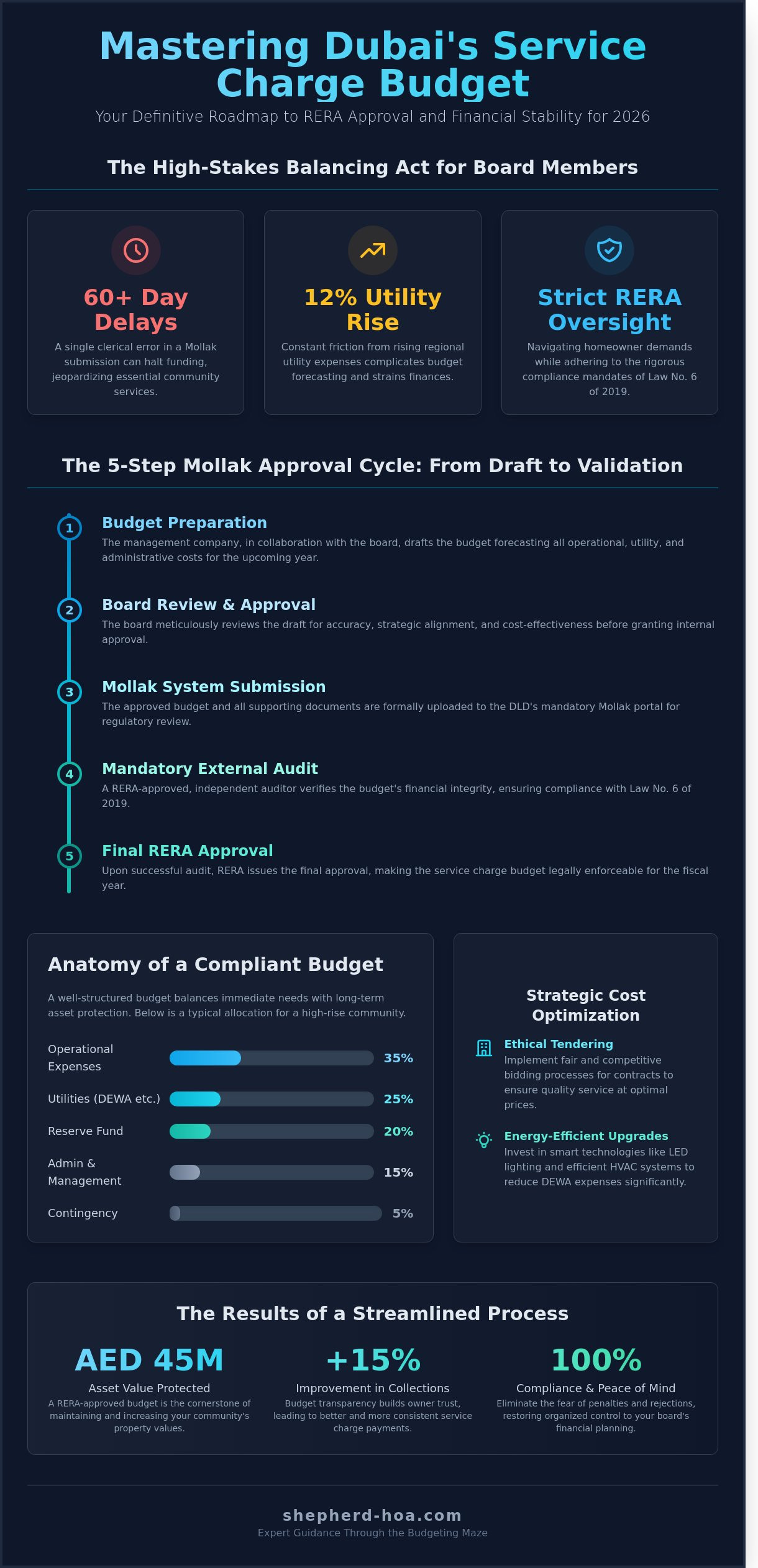
Managing a community service charge budget dubai requires a disciplined adherence to the regulatory framework established by the Dubai Land Department (DLD). Since the implementation of Law No. (6) of 2019, the Mollak system has served as the mandatory digital gateway for all service charge approvals. This structured cycle ensures that every fil (0.01 AED) requested from homeowners is justified, audited, and legally enforceable. The process follows five distinct stages designed to protect property values and ensure administrative transparency.
Step 1: Budget Preparation: The management company drafts the annual budget in coordination with the board. This draft includes projected operational expenses, utility costs based on historical consumption, and the mandatory 10% to 15% sinking fund allocation for long-term capital repairs.
Step 2: External Financial Audit: A RERA-approved auditor examines the draft. They verify that every projected cost is backed by valid service contracts or historical data, ensuring the budget isn't inflated.
Step 3: Portal Submission: The management team uploads the audited budget alongside all active service provider contracts to the Mollak portal. This digital trail provides a permanent record of the community's financial obligations.
Step 4: RERA Review: RERA officials review the submission against the Service Charge Index. They compare the proposed rates with similar projects in the same geographical zone to prevent unjustified increases.
Step 5: Invoice Distribution: Once RERA grants approval, the system triggers automated invoices. These are sent directly to owners through the Mollak system, ensuring 100% compliance with Dubai's electronic payment mandates.
Navigating the Audit Process
The audit phase is often where budgets face the most significant delays. RERA requires auditors to be selected from an approved list of registered firms to ensure high standards of fiduciary oversight. Common pitfalls include missing valid Ejari certificates for staff housing or outdated maintenance contracts that don't match the budget line items. Shepherd HOA eliminates these bottlenecks by providing an organized document repository that allows auditors to access every necessary contract and invoice instantly. This level of preparation can reduce the audit timeline by as much as 14 days, preventing late filing penalties.
The Role of the Owners Committee
While the management company handles the technical filing, the Owners Committee acts as a vital advisory body. Committee members have the legal right to review the community service charge budget dubai before it reaches the auditor. Their role is to balance community aspirations, like upgrading gym equipment, with the reality of RERA's strict cost-control measures. Effective boards prioritize transparency; they share draft figures early to gather feedback and avoid friction during the final approval stage. This partnership creates a sense of shared responsibility, transforming the budget from a source of stress into a tool for community stability and long-term asset protection.
General Fund vs. Reserve Fund: Balancing Today and Tomorrow
Effective community management relies on a clear distinction between short-term operational needs and long-term financial stability. Your community service charge budget dubai is split into two distinct buckets: the General Fund and the Reserve Fund. The General Fund handles the immediate 12-month operational cycle, covering recurring costs like DEWA bills for common areas, security contracts, and routine cleaning. In contrast, the Reserve Fund, often called a sinking fund, focuses on major capital expenditures occurring 5 to 10 years in the future. Dubai's Real Estate Regulatory Agency (RERA) mandates this separation to ensure that communities don't collapse financially when expensive infrastructure reaches the end of its life.
RERA guidelines, specifically those following Law No. (6) of 2019, require a professional reserve fund study every 3 years. This study uses an asset life-cycle analysis to predict exactly when high-value items will fail. For example, a central chiller system in a Dubai residential tower typically has a 15-year lifespan. If a replacement costs 1,200,000 AED, the board must ensure the reserve fund accumulates 80,000 AED annually for that specific asset. This proactive calculation prevents the sudden, massive price hikes that catch owners off guard. We act as a watchful guardian over these figures, ensuring your 10-year outlook is as clear as your monthly bank statement.
Managing the General Fund
Liquidity is the lifeblood of daily operations. We recommend allocating 5% to 10% of the budget to "Doubtful Debts" to protect the community against non-paying units. This ensures that even if a few owners are late, the bins are still collected and the lights stay on. If the previous financial year ended with a 50,000 AED surplus, this amount is typically credited back to owners or used to offset the next year's community service charge budget dubai. Shepherd’s real-time monitoring tools allow board members to see these fluctuations instantly, replacing end-of-year surprises with monthly clarity.
Securing the Reserve Fund
A healthy reserve fund is the single most important indicator of a well-managed community. It directly impacts property values; savvy buyers in Dubai now demand to see reserve fund balances before signing a Sales and Purchase Agreement. Without a robust fund, boards are forced to issue "special levies," which are one-off, mandatory payments that can exceed 20,000 AED per owner for emergency repairs. These levies cause friction and lower demand for the building. By conducting professional asset evaluations every 36 months, we help you maintain a steady contribution rate. This disciplined approach protects your investment and ensures the elevators, pumps, and cooling systems remain operational without financial trauma.
Maintaining this balance requires a methodical approach to financial oversight. It's not just about paying today's bills; it's about honoring the fiduciary duty to protect the community's future. When the General Fund is lean and the Reserve Fund is growing at the correct pace, the board can lead with total confidence. This structure provides the peace of mind that every homeowner deserves, knowing their property is shielded from both operational neglect and sudden financial shocks.
Strategies for Optimising Operational Costs in 2026
Managing a community service charge budget dubai residents feel is fair requires a shift from reactive spending to strategic oversight. In 2026, the most successful boards will move away from simply choosing the cheapest vendor. This "race to the bottom" often results in poor service, leading to higher long-term costs when work must be redone. Instead, we advocate for ethical tendering, where "best value" takes precedence over the lowest price tag. This means looking at a provider's track record, financial stability, and staff retention rates before signing any agreement.
Shepherd HOA acts as a watchful guardian for your community's funds. By leveraging our extensive portfolio of managed properties, we consolidate contracts to negotiate bulk rates that individual boards can't access alone. This approach typically secures a 12% discount on standard facilities management rates for our partners. We also emphasize the financial logic of preventative maintenance. Investing AED 3,000 in regular pump room checks prevents a total system failure that could cost AED 55,000 in emergency repairs. It's about protecting property values through disciplined, small-scale investments today rather than facing massive levies later.
Contract consolidation doesn't just save money; it improves accountability. When a single provider manages multiple services across a portfolio, they're more incentivized to maintain high standards to protect their broader relationship with the management company. This creates a layer of protection for the board, ensuring that vendors remain responsive and diligent. We've seen this strategy reduce administrative overhead by 8% as it streamlines communication and invoicing processes for the treasurer.
The Power of Competitive Tendering
Our transparent RFP process removes the guesswork from vendor selection. We help boards evaluate Service Level Agreements (SLAs) with a 70/30 weighting on technical capability versus cost. It's vital to hire vendors with at least 5 years of local Dubai experience. These professionals understand the specific challenges of the UAE climate and local regulatory requirements, ensuring your community complies with RERA standards without unnecessary fines or delays.
Utility Management and Sustainability
Utilities often account for 35% of a community's total operational spend. We help boards conduct energy audits to find "low-hanging fruit" like inefficient chiller settings. For example, a residential tower in Dubai Marina reduced its annual DEWA bill by 15% in 2025 after implementing smart HVAC controls and motion-sensor LED lighting. Water conservation in landscaping can save an additional AED 20,000 annually through smart irrigation sensors.
Ready to see how professional oversight can protect your community's financial health and lower your expenses? Learn how Shepherd HOA optimizes your budget today.
Shepherd HOA: Your Expert Guide Through the Budgeting Maze
Managing a residential community in Dubai demands more than just basic accounting skills. It requires a deep understanding of Law No. (6) of 2019 and the intricate RERA regulations that govern freehold properties. Shepherd HomeOwners' Association serves as the preferred partner for boards that value precision and transparency. We don't just fill out forms; we build robust financial frameworks that protect your property's long term value. Our team manages millions of AED in community funds, ensuring every dirham is accounted for and every expense aligns with the community's strategic goals.
The shepherding metaphor defines our entire approach to community management. Just as a shepherd protects the flock from external threats, we shield your community from financial mismanagement and compliance risks. We act as a watchful guardian over your assets. This means anticipating maintenance needs before they become costly emergencies and ensuring your community service charge budget dubai is submitted through the Mollak system without errors. Our presence provides the invisible backbone your board needs to lead with confidence rather than stress.
Our advantage lies in our technical mastery of the Mollak system. We maintain direct, professional relationships with RERA officials, which allows us to resolve registration bottlenecks quickly. In 2023, we helped communities reduce their administrative lead times by 25% through optimized filing processes. We understand the specific documentation RERA auditors look for, which minimizes the risk of budget rejections or delays that can freeze community operations.
Our Commitment to Fiduciary Excellence
Shepherd HOA sets a higher standard for financial reporting. While RERA requires annual audits, we provide quarterly progress reports that offer granular insights into your community's financial health. These reports break down actual spending versus budgeted projections, allowing boards to make data driven decisions in real time. We maintain an open door policy for homeowners, fostering a culture of trust through total transparency. Our team also provides monthly education sessions for board members to stay updated on evolving Dubai strata laws and new circulars from the Dubai Land Department.
Get Started with a Budget Review
The first step toward financial clarity is a comprehensive budget audit. During your initial consultation, our finance team reviews your previous three years of spending to identify waste and recovery opportunities. We often find that communities can save up to 15% on service contracts simply by renegotiating terms or consolidating vendors. If you decide to move forward, our transition process is designed to be seamless. We handle the entire data migration and vendor handover within a 45 day window, ensuring no disruption to community services. It's time to replace administrative headaches with organized control. You can request a professional budget evaluation from Shepherd HOA to begin your journey toward a more stable and transparent community future.
Future-Proof Your Community's Financial Success
Mastering a community service charge budget dubai requires more than basic accounting. It demands a precise understanding of the RERA approval cycle and the foresight to balance immediate General Fund needs with 2026 Reserve Fund requirements. You've identified how to optimize operational costs while navigating the Mollak system to ensure transparency for every homeowner. These steps aren't just administrative tasks; they're the foundation of a stable, thriving neighborhood.
Shepherd HOA serves as your expert guide through this complex landscape. We're a RERA-approved management firm with 15+ years of Dubai community management experience and have mastered the Mollak system since its inception. We provide the oversight and technical expertise needed to handle your fiduciary duties with confidence. It's time to replace the stress of budget season with the peace of mind that comes from professional, reliable management.
Your board has the power to protect property values and foster harmony. We're here to help you lead the way with confidence and clarity.
Frequently Asked Questions
How are service charges calculated in Dubai for 2026?
Service charges for 2026 are calculated by multiplying the total square footage of your property by the specific rate per square foot approved by RERA for your building. This calculation includes your unit's proportional share of the master community's operational expenses and the building's specific maintenance costs. For example, a 1,200 sq. ft. apartment in Dubai Marina with a rate of AED 16 per sq. ft. results in an annual community service charge budget dubai of AED 19,200.
Can a developer increase service charges without RERA approval?
No, a developer cannot increase service charges without explicit, documented approval from RERA. Under Law No. 6 of 2019, all budget proposals must be submitted through the Mollak system for a thorough audit before any invoices are issued to owners. This regulation ensures that 100% of fee adjustments are backed by actual operational needs, protecting homeowners from arbitrary price hikes.
What happens if I don't pay my service charges in Dubai?
If you don't pay your service charges, the management company will issue a formal legal notice through the Mollak system giving you 30 days to settle the debt. If the balance remains unpaid, the case is escalated to the Rental Disputes Center (RDC), which has the authority to issue a travel ban or authorize the auction of the property to recover the AED balance. These measures act as a safeguard to ensure the community's financial stability isn't compromised by individual defaults.
Is the Mollak system mandatory for all communities?
The Mollak system is mandatory for every freehold community and homeowners association operating in Dubai. Since its full implementation by the Dubai Land Department in 2019, the platform has served as the only legal gateway for processing service charge invoices and managing community bank accounts. This system provides a transparent trail for every AED in the community service charge budget dubai, ensuring funds are used solely for the community's benefit.
How often should a community conduct a Reserve Fund Study?
A community should conduct a professional Reserve Fund Study every 3 years to ensure it remains a watchful guardian of its long-term assets. This study provides a 10-year financial roadmap that identifies when major components, like chiller systems or roofing, will require replacement. Maintaining this schedule prevents the need for sudden special levies, which can often exceed AED 40,000 per owner for unplanned structural repairs.
Can homeowners dispute an approved service charge budget?
Homeowners can dispute an approved budget by filing a formal case with the Rental Disputes Center (RDC) if they have evidence of financial mismanagement or inflated costs. While the Mollak system filters out most errors, owners have the right to challenge specific line items that deviate significantly from previous years without justification. You'll typically need to pay a filing fee equal to 3.5% of the disputed amount to initiate this legal review process.
What is the RERA Service Charge Index and how does it affect my budget?
The RERA Service Charge Index is an online benchmarking tool that provides the average cost per square foot for maintenance across 20 different zones in Dubai. It affects your budget by setting a market standard that management companies must justify if they choose to exceed it. If your community's rate is 20% higher than the index average for your area, it serves as a clear signal for the board to renegotiate vendor contracts and seek better value for the residents.
What are the management fees typically included in a Dubai HOA budget?
Management fees in a Dubai HOA budget typically cover the administrative oversight, financial reporting, and regulatory compliance tasks performed by a licensed management firm. These fees generally range from 5% to 10% of the total annual operating expenditure, depending on the number of units in the development. This investment provides the professional backbone needed to handle complex RERA filings and ensures the community operates with organized control and transparency.


Comments